



Category: general. Audience: B2C.
Siem-Reap or Siem Reap is a very well-known tourist city in Cambodia, with the Angkor archaeological complex, located 314 km north-northwest of Phnom Penh. This city has colonial and Chinese-style architecture, especially in the French Quarter and around the Old Market.
Siem Reap is a well-known tourist city in Cambodia, home to the Angkor archaeological complex, located 314 km north-northwest of Phnom Penh. This city features colonial and Chinese-style architecture, especially in the French Quarter and around the Old Market.
1/ The city of Siem Reap
Siem Reap is the capital of Siem Reap province, located in Cambodia, near the Angkor archaeological complex and approximately 314 km north-northwest of the capital Phnom Penh.
This city features colonial and Chinese-style architecture, especially in the French Quarter and around the Old Market. In the city, you can find Apsara dance festivals, artisan shops, silk farms, rice paddies, fishing villages, and bird sanctuaries near Tonlé Sap Lake.
It is a rapidly developing city due to the booming tourist attraction of the Angkor temples since the end of the war and the last Khmer Rouge attacks that occurred until 1994. Tourism has particularly accelerated since the 2000s. Many hotels have been built there, and others are under construction, thanks in part to foreign capital. Many small establishments are concentrated around the Old Market, while the more expensive hotels are located between Siem Reap-Angkor International Airport and Siem Reap along National Road 6. There is also a variety of mid-range hotels and restaurants along Sivatha Street and in the Phsar Leu area. There are still some pre-independence buildings, known as Chinese compartments.
It is also the name of a sacred river tributary to the Tonlé Sap.
2/ History of Siem Reap
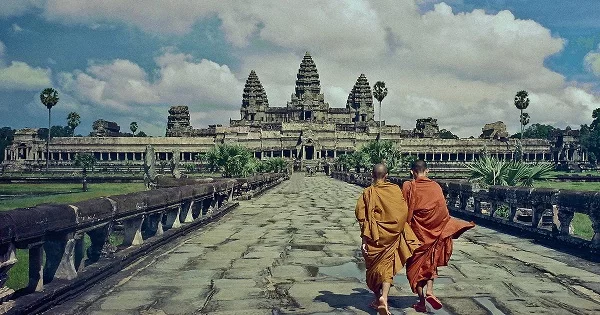
Siem Reap means "Siamese defeat" and refers to a battle between Siamese and Khmer armies... which saw the victory of the latter.
In 1901, the École française d'Extrême-Orient (EFEO) began a long association with Angkor by carrying out the first clearing and photographic documentation work at the Bayon temple. In 1907, the province of Siem Reap, which had been under Siamese control for over a century, was ceded back to Cambodia, and the EFEO was given responsibility for the clearing, restoration, and maintenance of the Angkor site. To do this, it created the Conservation d'Angkor and retained its scientific direction after independence, until the Khmer Rouge took power in 1975.
From the very first year, the first tourists arrived in Angkor. In three months, the city recorded 200 visitors, which had never happened before. However, considering that Angkor had been "saved" from the jungle is a typically European tropism, which contributes to perpetuating the myth of the "discovery" of Angkor by the West - largely instrumentalized in the context of 19th-century colonial expansion. Meanwhile, Angkor Wat was widely known and had remained one of the major Buddhist pilgrimage sites in Southeast Asia.
3/ Angkor Wat
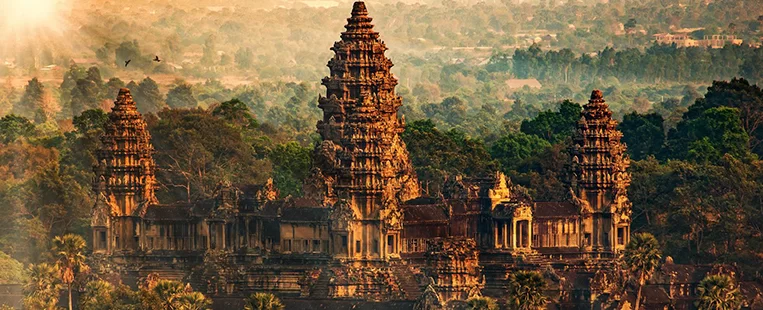
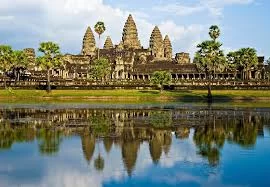
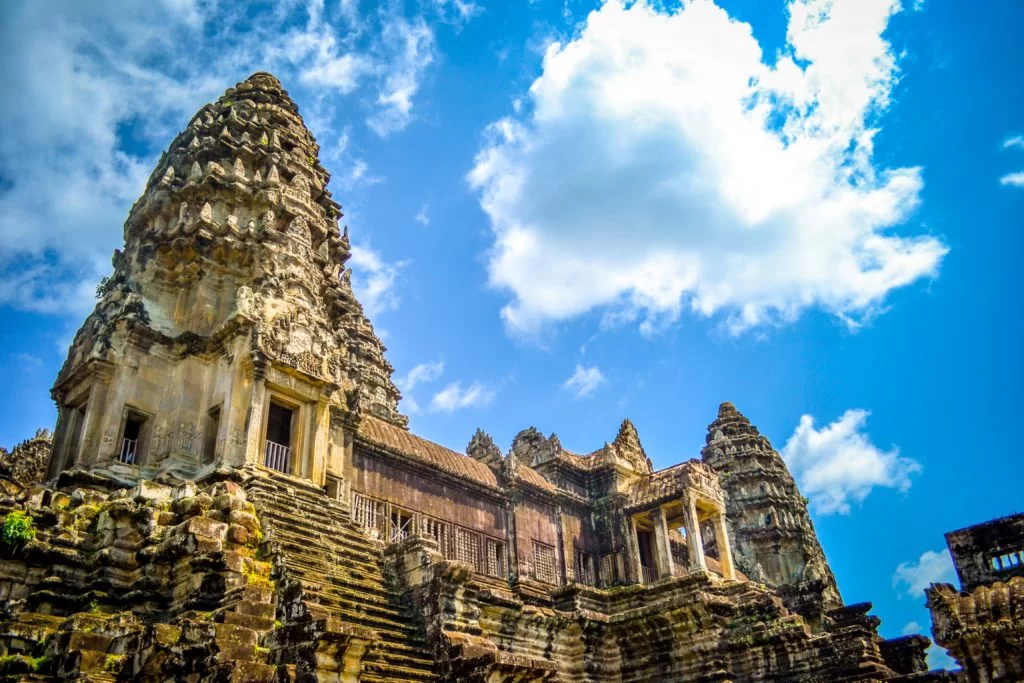
Angkor Wat is the largest and most harmonious of the temples in the monumental complex of Angkor, Cambodia. It is one of the best-preserved examples of Khmer architecture.
*/ The temple viewed from the West
Angkor is a dialectal form of the word nokor, which comes from the Sanskrit nāgara, "royal residence," and vat means "temple" in Khmer. Angkor Wat can be translated as the city that is a temple. Its beauty and size are such that many consider it the eighth wonder of the world.
*/ History of Angkor Wat
Angkor Wat was built by King Suryavarman II (who reigned from 1113 to 1150) in the first half of the 12th century, as Aymonier already believed. At that time, the state temple in the center of the capital, the Baphuon, was dedicated to Shiva. As Suryavarman II honored Vishnu, he decided to build a new temple south of the city. This explains why the entrance to Angkor Wat faces west (towards Vishnu), unlike other Khmer temples. Later, the temple was "diverted" to the worship of Buddha with a notable redesign of the central sanctuary.
Even today, the temple is visited daily by Buddhist monks. Its silhouette appears on the flag of Cambodia.
*/ The outer enclosure viewed from the moats
The complex occupies a total area of 1500 meters by 1300 meters. The abundant but harmonious Khmer decoration is mainly made of representations of gods, men, and animals, which fill every flat surface. Battles and episodes from legends are frequent. Floral decorations are reserved for borders, moldings, and capitals. The main materials used are sandstones of different colors and laterite. The stone was cut into enormous blocks assembled with great precision without using cement, probably by grinding on site.
*/ The second enclosure viewed from the Northwest
Moats and three galleries encircle the central sanctuary. From the west of the complex, a paved causeway 200 meters long crosses the moats and leads to a wide terrace preceding the magnificent gopura, which marks the main entrance to the central edifice.
The first gallery consists of square pillars facing outwards and a blind wall facing inwards. The ceiling between the pillars is decorated with lotus rosettes. The exterior of the blind wall is decorated with columned windows, apsaras (celestial nymphs), which are found on all galleries, and male figures dancing on prancing animals.
From the first gallery, an avenue decorated with nāgas, 350 meters long, leads to the second enclosure through a park. On either side of this alley, one first encounters two constructions whose purpose is unknown (but which are commonly called "libraries"), then two small ponds. One reaches the second gallery via a raised platform flanked by lions on either side of a stairwell. The inner wall of the second gallery is adorned with a narrative bas-relief along its entire length. On the western wall are depicted scenes from the Mahābhārata epic.
*/ The third enclosure of the temple
Inner courtyards
*/ One of the libraries of the 2nd enclosure
The third gallery delimits an area of 150 meters by 200 meters. One enters it via a cross-shaped terrace. This space is divided into three levels, connected by numerous exterior staircases. These levels are of decreasing dimensions. Each level is formed by a terrace surrounded by a gallery. The highest is the sanctuary, which is surmounted in its center by a large pyramidal tower. Towers also surmount the four corners of the terraces of the two upper floors. The outer gallery of the central sanctuary, 800 meters long, is decorated with bas-reliefs describing scenes taken from Indian epics or the history of Angkor. Three galleries whose vaults are supported by columns lead from the three western gates of the third gallery to the second level. They are connected by a transverse gallery, thus forming four square basins. The southern gallery is nicknamed the gallery of a thousand Buddhas, as the Khmers used to leave Buddha statues there. Most of these were destroyed during the civil war. On either side of these galleries are two libraries.
One thus reaches the second level by crossing a portico through another rectangular enclosure. There is a paved surface, where two more libraries are located. These courtyards may originally have been flooded, to represent the ocean surrounding the mythical Mount Meru. It is crossed by a short alley supported by pillars and leading to the third level.
*/ The central sanctuary of the temple
Third gallery; northwest tower
This is reached by twelve very steep staircases, which represent the difficulty of reaching the realm of the gods. At the top of these staircases is a square paved platform divided into four courtyards by two raised corridors that intersect at right angles. Another raised corridor runs along the outer edge of the platform, surrounding the entire level. At each corner of this corridor is a tower, and a fifth is found in the middle of the platform. These five towers form the well-known silhouette of Angkor Wat. The square base of the central tower contains a small sanctuary on each face, behind which is the central sanctuary. These sanctuaries are connected by galleries on the roofs of which is represented the body of a serpent ending in lion or garuda heads. Sculpted lintels and pediments adorn the entrances to the galleries and sanctuaries.
The central sanctuary was initially dedicated to the Hindu god Viṣṇu, but his golden statue has been removed and today Buddha statues are found in each sanctuary.
4/ Angkor Thom
Angkor Thom was the royal city built by Jayavarman VII (who probably reigned from 1181 to 1220), a Buddhist king of the Khmer Empire, at the end of the 12th century and the beginning of the 13th century, after Angkor was conquered and destroyed by the Chams. Its current name, Angkor Thom, means "the great city"; its Khmer name was Mahānagara.
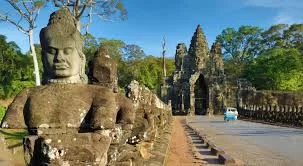
This city is located about two kilometers from the right bank of the Siem Reap, a tributary river of the Tonlé Sap.
*/ The South Gate, viewed from inside the enclosure
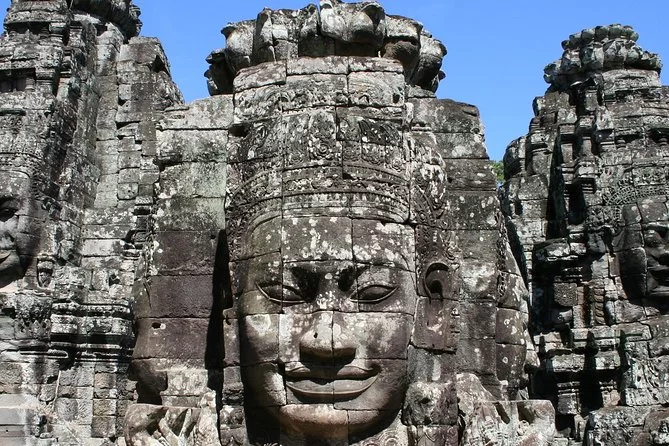
The royal city has the shape of a quadrilateral, about three kilometers long and wide, surrounded by an eight-meter-high rampart bordered by moats. In the middle of each of the four walls of the enclosure is a monumental gate, adorned with immense faces of one of the four Great Kings of the Hindu pantheon and the representation of Indra riding his three-headed elephant.
These four gates are connected by two perpendicular roads that meet at the center of the enclosure where the Bayon is located. A fifth gate, the Victory Gate, is located slightly north of the East wall gate (the Death Gate) and allowed access to the Terrace of the Elephants of the Royal Palace, via a paved road probably intended to host victorious parades. This gate is in alignment with the center of the eastern bārāy, marked by the Mebon.
Each gate corresponds to a causeway that crosses the moats. These causeways are guarded on each side by 54 giants, yakṣa, who hold the fabulous serpent, the nāga, standing guard in front of the four great kings. The constructions of Jayavarman VII are representative by their decoration of the successful syncretism by the Khmers between Mahāyāna Buddhism and the Hindu cults of Śiva and Viṣṇu.
*/ The monuments
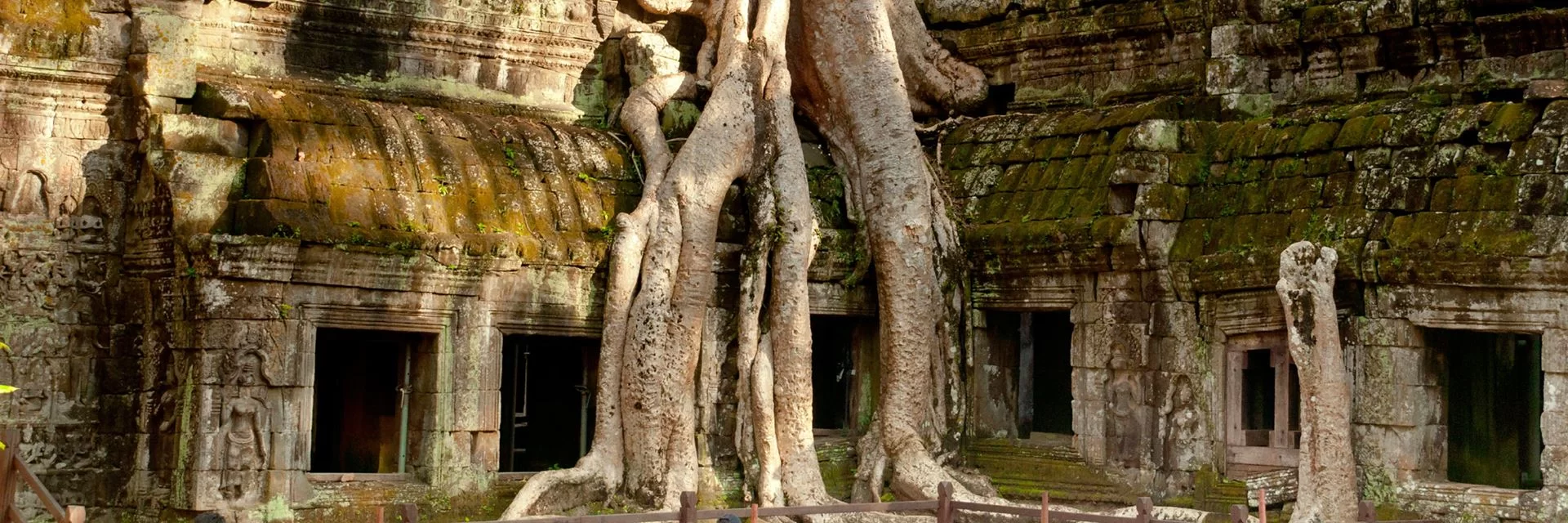
Inside this enclosure are the ruins of palaces, temples, and other buildings, overgrown by the forest. The main ones are:
the remains of the Royal Palace, built under the reign of Suryavarman I, 150 years before the erection of the enclosure;
the Phimeanakas, a pyramidal religious structure located within the same enclosure as the Royal Palace, a Celestial Palace where, according to legend, the king spent the first part of each night with the Sun Queen;
the Terrace of the Elephants which overlooks the royal square and on which the entrance to the Royal Palace opened, and the Terrace of the Leper King, located north of it;
the Bayon temple, state temple of Jayavarman VII;
two small Buddhist temples: the Preah Palilay, with a single tower, decorated with scenes from the life of Buddha, and the Tep Pranam of which little remains but a very large statue of the seated Buddha;
two buildings whose purpose remains mysterious: the North and South Khleang
bordering to the east the road from the Bayon to the North Gate, twelve small towers called Prasat Sour Prat for festive use;
Angkor Thom had a very sophisticated water management system:
in the southwest corner, the Bang Thom collects wastewater collected by a ditch running at the foot of the wall, west of the Royal Palace, a small baray was fed by a canal from the western baray within the palace enclosure, the large royal pond, about 40 m by 120 m, whose coping is finely sculpted.
* If this article interests you and is useful, please share it with your Friends and the people around you.
* If you wish to travel to Cambodia to discover all its beauty and charms with a 100% customized trip, the agency TypicTravel, a local expert, offers to create a tailor-made trip according to your wishes.
* If you are looking for travel ideas, Typic Travel allows itself to propose some main ideas according to the category of our trips:
You can send us an email by clicking HERE or easily follow us on our social networks for permanent updates:
| Follow us on: | TripAdvisor | Facebook | Petit Futé | Youtube | Twitter | Instagram |


