




The Plain of Jars
Industry: general. Audience: B2C. General context of the article (for consistent terminology, no need to translate this part): La plaine des Jarres MANDATORY RULES: - Keep proper nouns, place names, and brand names untranslated (especially those listed above). - Keep ALL HTML tags INTACT, do not add/remove/change tags, ONLY translate the text. - Return only the translation, DO NOT add explanations, DO NOT wrap in ```. Text to translate: The Plain of Jars is a region in northern Laos located in Xieng Khouang province, notable for the presence of fields of imposing ancient stone jars, whose meaning and origin are not yet fully understood. It covers an area of approximately 1,000 KM2
The Plain of Jars is a region in northern Laos located in Xieng Khouang province, notable for the presence of fields of imposing ancient stone jars, whose meaning and origin are not yet fully elucidated. It covers an area of approximately 1,000 KM2
1/ The Plain of Jars
A beautiful place in the northern region of Laos located in Xieng Khouang province, notable for the presence of fields of imposing ancient stone jars, whose meaning and origin are not yet fully elucidated. It covers an area of approximately 1,000 km2
2/ Location of the Plain of Jars
The main jar fields are located in Xieng Khouang province, on a plateau around Phonsavan. This plateau has an average altitude of 1,200 meters; it is there that the main concentrations of jars are found.
This sector was among the most heavily bombed regions by American aviation during the Vietnam War: more than 500 air attacks per month according to the Rolling Thunder program, figures taken from the Pentagon Papers, or one attack every eight minutes for nine years according to journalist Fred Branfman who denounced this useless pounding in his book Voices from the Plain of Jars: Life under an Air War. Branfman proved, with supporting maps, that the Plain of Jars was not on the route of the Ho Chi Minh Trail which the North Vietnamese used to supply weapons to the fighters in the South. Many unexploded bombs are still present, which makes the study and visit of the jar areas very dangerous: currently, only three areas (site 1, 2, 3) are open to visitors.
In total, more than sixty different sites are scattered over the area of the Plain of Jars, whose center is in Laos, with the main concentrations numbering up to 250 units. But similar sites, though less spectacular, are also found on the Korat plateau in Thailand and in North India, which leads some researchers to consider a distribution covering a caravan trade route.
Currently, efforts are underway to classify the Plain of Jars on the UNESCO World Heritage list, and demining campaigns are being carried out by international organizations.
Only three sites are open to the public, including Thong Hai Hin, with 250 jars weighing from 600 kilograms to 6 tons.
3/ Nature of the Plain of Jars
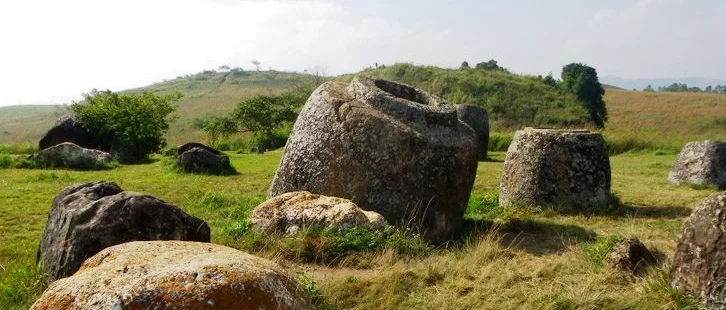
A jar from site 1 with a lid.
The jars are arranged in groups, without visible alignment. They are of different sizes, from one to three meters in height, measuring up to nearly eight meters in circumference, weighing from 500 kg to several tons for the largest (which can contain up to ten standing men). They were carved from monolithic rock blocks from the region: sandstone limestone, and sometimes granite. They are sometimes half-buried.
Sometimes, near some of them, a stone disc that could have served as a lid is also found. Their shape is quite simple, often cylindrical, more rarely angular; the jars have no decorations or inscriptions. No other architectural remains or ancient habitations are present in the region, leaving the jars without archaeological context.
4/ Archaeological study of the Plain of Jars
The first archaeological study of the sites was carried out around 1930 by Madeleine Colani of the French School of the Far East. She undertook excavations on several jars, as well as in a cave located not far from site 1 and equipped with a natural chimney, in which important traces of fire and calcined human bones were discovered. She then hypothesized that this cave would have been a natural incinerator during funerals, and that the ashes would then have been preserved in the jars. Unfortunately, the dating elements of the bones found in the cave or near the jars are very spread out in time, and do not allow precise conclusions to be drawn.
Madeleine Colani's work remains a basis for archaeologists seeking to unravel the mystery of the Plain of Jars, among whom is Marcello Zego. He hypothesizes that these megaliths, accompanied by bronze and iron objects, could be funerary monuments, works of the first Indochinese occupants of a civilization located between that of the Kha aborigines and Cambodian.
The scientific community can still only give conjectural explanations as to the dating of these stone jars, over a period ranging from 5000 BC to 800 AD; and there are several theories about their purpose: funerary urns, storage of food or water, fermentation vats for alcohol production... None explains the number of these megaliths weighing between 600 kg and 7 tons, nor how they were brought to the five sites of the plain when the sandstone from which they are carved comes from the mountain range located between Luang Prabang and Xieng Khouang. Local legends are countless, and the inhabitants of the region continue to invent them for tourists.
* If you are interested in this article and find it useful, please share it with your friends and the people around you.
* If you wish to travel to Laos to discover all its beauty and charms with a 100% personalized trip, the agency TypicTravel, a local expert, offers you a tailor-made trip according to your wishes.
* If you are looking for travel ideas, Typic Travel allows itself to propose some main ideas according to our travel categories:
- Essential Trips
- Off the Beaten Path
- Hiking - Trekking
- Multi-Country Combinations
- Family Trips
- Themed Trips
- Photo Tours
- Deluxe Trips
- Honeymoon Trips
- Culinary Trips
- Cruises & Holidays
- Beach Stays & Short Tours
- Popular Trips
- Heartfelt Novelties
You can send us an email by clicking HERE or easily follow us on our social networks for permanent updates:
| Follow us on: | TripAdvisor | Facebook | Petit Futé | Youtube | Twitter | Instagram |


