




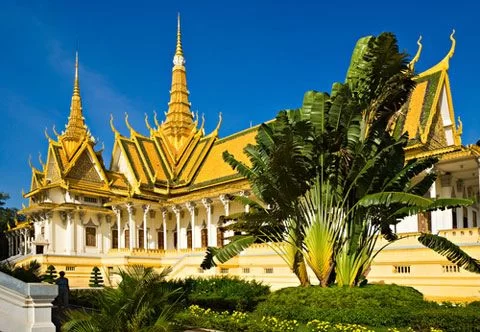
Kingdom of Pnom Penh
Phnom Penh (Khmer: Krong Phnom Penh) is the capital of Cambodia, located in the southern half of the country, at the confluence of the Tonlé Sap and Mekong rivers. One million five hundred thousand Phnompenhois live on the 290 km² territory of the Phnom Penh municipality.
Phnom Penh (Khmer: Krong Phnom Penh) is the capital of Cambodia, located in the southern half of the country, at the confluence of the Tonlé Sap and Mekong rivers. One million five hundred thousand Phnom Penh residents live on the 290 km² territory of the Phnom Penh municipality.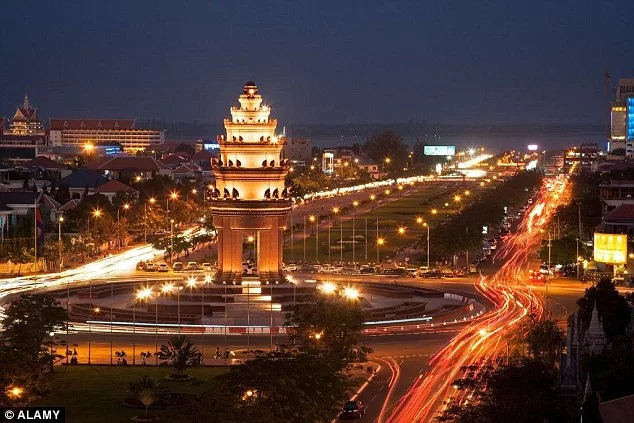
1/ Capital or Kingdom of Phnom Penh
Phnom Penh (Khmer: Krong Phnom Penh) is the capital of Cambodia, located in the southern half of the country, at the confluence of the Tonlé Sap and Mekong rivers. One million five hundred thousand Phnom Penh residents live on the 290 km² territory of the Phnom Penh municipality. Administratively, Phnom Penh is also a province of Cambodia and Keb Chutema is its current governor.
Having become the capital of the Kingdom during the French colonial era, Phnom Penh was nicknamed the "Pearl of Asia" in the 1920s. Founded in 1434, the city developed significantly under the impetus of the French, leaving a legacy of many buildings with European and colonial architecture, particularly along the grand boulevards. Today, Phnom Penh is the most populous city in Cambodia as well as its economic and political center.
The city is built at the intersection of "four rivers": the upper Mekong, the lower Mekong, the Tonlé Sap (a tributary coming from the great lake) and the Bassac, the first arm to detach from the great river.
This intersection gave the city its old name of Krong Chaktomuk (Khmer: ក្រុងចតុម្មុខ) meaning "the city with four faces".
The city includes other bodies of water, notably Boeung Kak lake, the two Boeung Trabek lakes and Pempeay lake.
Finally, since the French colonial era, Phnom Penh has also been the central hub of the Cambodian road network. The capital is thus located at the intersection of all national roads which serve the different provinces of the Kingdom as well as neighboring states such as Thailand, Laos and Vietnam.
2/ Climate of Phnom Penh
Phnom Penh has a tropical climate.
The city experiences two seasons. The rainy season, from May to October, can see temperatures rise to 47 °C and is generally accompanied by high humidity. The dry season, from November to April, experiences lower temperatures.
The city takes its name from Wat Phnom Daun Penh (now known only as Wat Phnom, or "temple hill" វត្តភ្នំ), a religious edifice built in 1373 to house five Buddha statues on a 27 m high mound. Daun Penh ("Grandmother Penh") was a wealthy widow who is said to have had it built.
The city became the capital of Cambodia after Ponhea, king of the Khmer empire, fled Angkor Thom when that city was captured by Siam in 1431. A stupa located behind Wat Phnom houses the remains of Ponhea Yat and the royal family. There are also vestiges of Buddhist statues from the Angkor era.
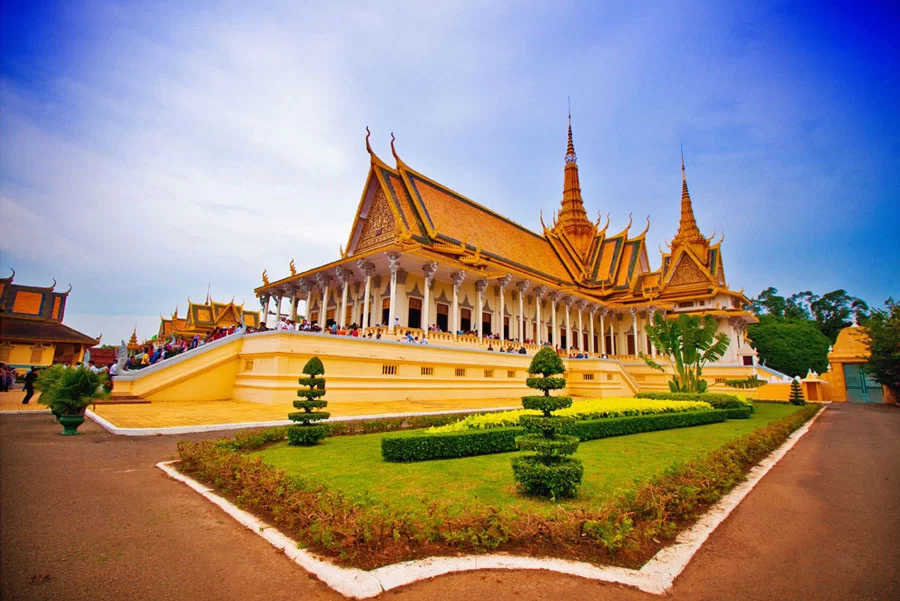
3/ Sites to visit in Phnom Penh:
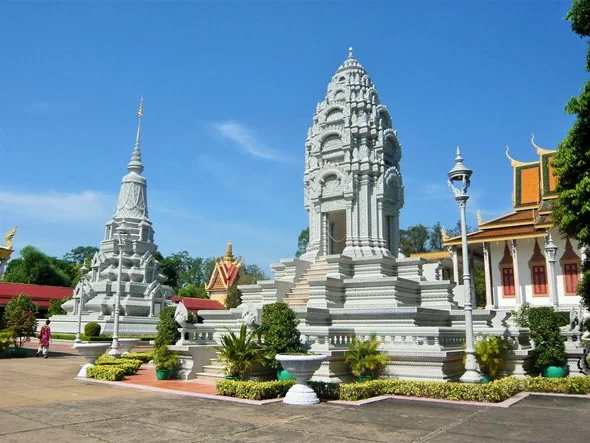
*/ The Royal Palace.
However, it was not until 1866 under the reign of Norodom that Phnom Penh became the permanent seat of government, and the royal palace was built. This marked the beginning of the transformation of what was essentially a village into a large city, with French colonization expanding the canal system to control wetlands, building roads and a port. Since then, the city has presented an impressive number of Art Deco buildings, some unfortunately in poor condition, and numerous colonial villas.
In the 1920s and until 1970, Phnom Penh was known as the Pearl of Asia. Throughout the next four decades, it continued to expand with the construction of a railway line to Sihanoukville (Kompong Som) and the international airport. In April 1967, Singapore's Prime Minister Lee Kuan Yew made a state visit and was impressed by the beauty and development of Phnom Penh; he confided to his host Norodom Sihanouk: "I hope that one day my city will resemble yours", and recommended that his Ministers draw inspiration from its development model.
War and terror
During the Vietnam War, Cambodia, including Phnom Penh from 1970, was used as a base by the Viet Cong army, and thousands of refugees from all over the country flooded the city to escape fighting between government troops, the Viet Cong, South Vietnamese troops and their allies, and the Khmer Rouge. During the five years of civil war of Lon Nol's government, the city was cut off, then besieged and bombed by communist troops. Supplies were only made possible by convoys along the Mekong from South Vietnam, and Phnom Penh Pochentong airport.
In 1975 the population reached two million. The city fell to the Khmer Rouge of Democratic Kampuchea on April 17, the day of the Cambodian New Year, and was forcibly evacuated; its residents had to go work on rural farms as new citizens, or new people ("procheachun thmey"), so designated because they were considered newcomers compared to those who already lived in the countryside.
In one day, the city was emptied of almost all of its 2 million inhabitants, and left abandoned for 3 years, 8 months and 20 days.
Tuol Svay Prey school was transformed by Polpot's forces into the S-21 prison and torture center. It is now the Tuol Sleng museum which, along with Choeung Ek, fifteen kilometers away, is a memorial to those who perished due to this regime.
*/ The Central Post Office of Phnom Penh.
The Khmer Rouge were driven out of Phnom Penh by the Vietnamese on January 7, 1979, and people began to return to the city. 80% of the pre-war inhabitants had perished due to executions, torture, and deprivation during the Khmer Rouge years. After almost four years of abandonment, the city's infrastructure was severely damaged and barely functional. The city remained cut off from the Western world for 12 years.
A period of reconstruction began in 1991, after the Paris agreements, aided by government stability, attracting foreign investment and aid from countries such as France, Australia, Korea, China, and Japan, and supranational organizations, particularly for drinking water supply, roads, and other infrastructure.
*/ National Museum
*/ Silver Pagoda in the Palace
4/ Recent Development in Phnom Penh
The city has recently experienced anarchic development, disregarding any urban planning. Many colonial-era buildings and public edifices such as the Brasseries et Glacière de l'Indochine (BGI), the Main Police Station, the old T-3 prison, were sold and demolished and replaced by recent constructions. The city has thus lost much of the charm that characterized it. In 2012, it had no public transportation.
The recent years from 2005 to 2009 saw a period of euphoria and real estate speculation. Many real estate projects have emerged since this period. Buildings of more than 30 floors are now being built in the city center, disrupting the perspectives of the grand colonial boulevards.
5/ How to get to Phnom Penh:
*/ By boat from Vietnam
*/ By road from Vietnam and Thailand
*/ By plane, from Vietnam, Laos, Thailand and others
* If you are interested in this article and find it useful, please share it with your friends and people around you.
* If you wish to travel to Cambodia from Phnom Penh to discover all its beauty and charms with a 100% personalized trip, the TypicTravel agency, a local expert, offers to create a tailor-made trip according to your wishes.
* If you are looking for travel ideas Typic Travel allows itself to propose some main ideas according to the category of our trips:
- Essential Trips
- Off the Beaten Path
- Hiking - Trekking
- Multi-Country Combinations
- Family Trips
- Themed Trips
You can send us an email by clicking HERE or easily follow us on our social networks for permanent updates:
| Follow us on: | TripAdvisor | Facebook | Petit Futé | Youtube | Twitter | Instagram |


