


The Caodaism
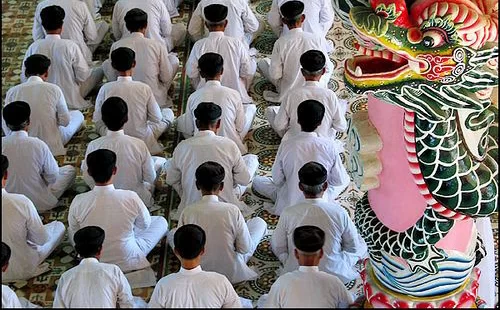
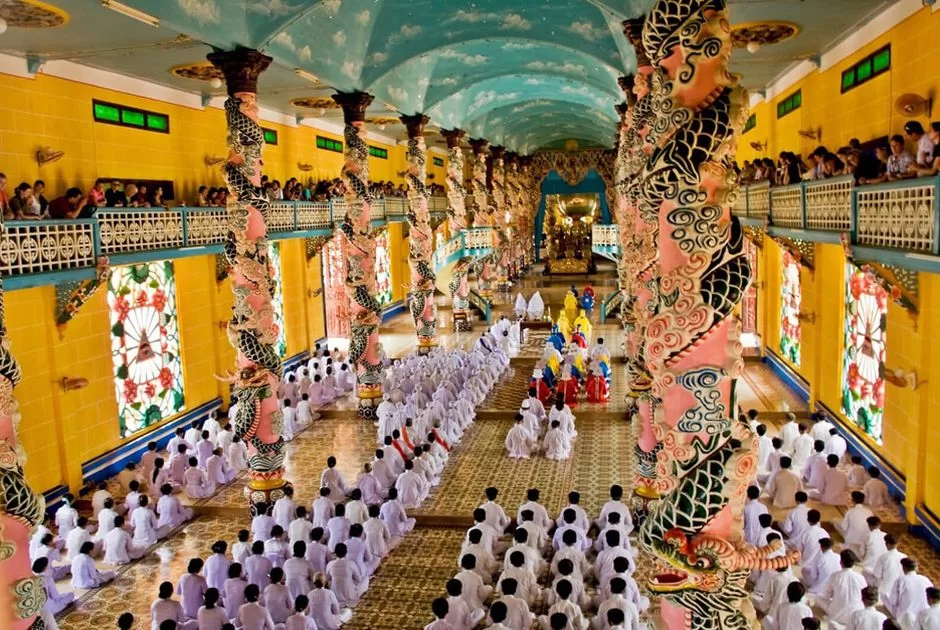
The word Caodaism comes from Cao-Dài, the literal translation of which is: Supreme Palace. This double term is found in the most ancient Buddhist prayers. This indicates the main origin of this religion, which is primarily, as we will see, that of renovated Buddhism.
The word Caodaism comes from Cao-Dài, whose literal translation corresponds to: Supreme Palace. This double term is found in the most ancient Buddhist prayers. This situates the main origin of this religion, which is primarily, as we will see, that of renewed Buddhism.
1/ Caodaism
The word Caodaism comes from Cao-Dài, whose literal translation corresponds to: Supreme Palace. This double term is found in the most ancient Buddhist prayers. This situates the main origin of this religion, which is primarily, as we will see, that of renewed Buddhism.
A new religion (its essential message dates back to 1926), it draws its roots from the most proven traditions of Buddhism and the purest revelations.
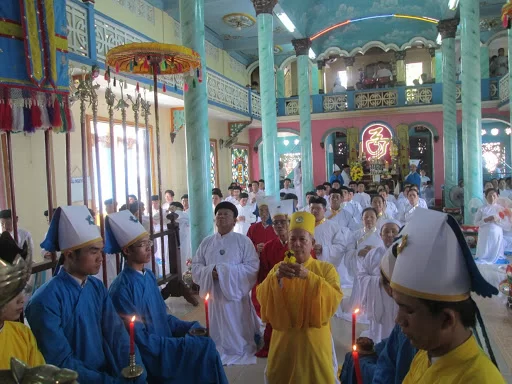
Caodaism is, to a certain extent, comparable to what Protestantism was, at its origin, in relation to Roman Catholicism. Moreover, even this possibility of comparison is already surpassed in a beneficial sense, that is to say, in the sense of good understanding, as it is now possible to envisage for a more or less distant future the union of Christian Churches in a total Catholic unity.
What characterizes Caodaism is its spirit of synthesis. This is why its conciliatory role can render great services to religious peace, and thus to peace itself.
There is no sectarianism in Caodaism; therefore, instead of tending towards opposition between religions, this new religion constitutes and will increasingly constitute a permanent invitation to good understanding between the various religious, mystical, philosophical, or esoteric obediences.
Good understanding of all spiritual forces that should give the world better harmony on all levels.
Our late friend, Gabriel Gobron, wanted to show the beauty, realities, and effectiveness of the Caodaist religion while expounding its history and practice.
Gabriel Gobron, born in Bayonville on July 5, 1895, left his earthly and suffering body on July 8, 1941, in Rethel.
An emeritus polyglot, an tireless researcher in the world of the Spirit and spirits, a novelist, historian, journalist, professor, Gabriel Gobron was a curious and also a curious man. A big heart, through his overflowing intellectual generosity, he was an ardent polemicist.
Curious certainly, but without dilettantism when he thought he had discovered a spiritual beauty, a philosophical or religious truth, he immediately wanted to make it known, to share it. He did not hesitate to fight, always with fervor, those who, in his eyes, wanted to put the light under a bushel. This is how he discovered Caodaism, this is how he fought until his last breath, praying for its blossoming. Gabriel Gobron, a great intelligence, was above all a great heart.
After a period of research, studies, and discoveries from 1930, Gabriel Gobron was a convinced propagator, an enlightened initiator, and soon, officially accredited with Caodaism in the West and more particularly in France.
Conferences, articles, and studies followed one another, and with unpublished texts, they formed a copious dossier of which the present posthumous book is one of the main parts.
Thus, the present work constitutes an authentic message from the Beyond. It was a very comforting task for us to finalize this text and, alas! to reduce it to two hundred pages.
A message from the Beyond, this posthumous work will, we hope, be particularly well received by the author's many spiritualist friends who did so much, through writing, speech, and experimentation, for Spiritualism.
It is, one can well say, Spiritualism that led Gabriel Gobron to Caodaism because, as we will see, this religion, a true renewed Buddhism, had at its origin, and still retains, certain links with Spiritualism. Hence the second subtitle dictated by Gabriel Gobron: Annamite Spiritualism.
Out of respect for the author's memory, as well as for the accuracy of presentation, we have kept these two subtitles which perfectly qualify: Caodaism, renewed Buddhism and Annamite Spiritualism. We could have, to be complete, added: synthesis of religions. This would have been to encroach on a work that we hope to reveal to the public later if we are given the necessary encouragement. Encouragement that is of a purely spiritual order.
For Caodaism, born of spiritualism, renewed Buddhism and then blossomed into a harmonious synthesis of religions. This without losing anything of what was best in its spiritualist origin, nor of its Buddhist formation.
A true theosophy, the Caodaist doctrine attracting into itself, in perfect selection, all that other religions had of good, beautiful, and, above all, essential, whether in practical morality, in ritual, or in philosophy.
The great modesty of Brother Gago (this is how the Caodaists of Indochina called Gabriel Gobron) would have willingly limited his role to that of a lawyer-polemicist, a propagandist of the new religion. His studies, his meditations, his mysticism earned him more. One can say today that he is the first philosopher and the first historian of Caodaism.
His work seemed unfinished when he left the daily routine of life for the eternal East; with the publication of this book, his value as a historian of Caodaism is confirmed.
From the Beyond, Brother Gago enlightens and protects us, for such was the profound will of his Faith.
Piously, let us listen to him accept his mission with a humility that is entirely Caodaist:
"If we have accepted this thankless role as the first historian of Caodaism, it is because our brothers and friends in Annam, in their excessive indulgence, judged that we were one of the best-documented Westerners on the progress and tribulations of renewed Buddhism.
A precarious health hardly favors the overwhelming duties of such a charge. We apologize to the attentive reader for all the imperfections of our work, we only ask him, above all, to forgive us when we happen not to be "in line", that is to say fraternal, even towards our adversaries and our enemies: It is then that the Caodaist will have been unworthy, he will not even have reached the Lordship of himself, the sick man will have torn off his cap in a fit of temper and trampled the most sublime pages of Christ, of Buddha, of Confucius..."
With compunction, we have transmitted the message, it only remains for us to be silent to let the reader read, freed from our comments, the first posthumous book of Gabriel Gobron.
2/ The origins of Annamite spiritualism
*/ The first Caodaist
It was at the beginning of the Binh-Dân year (1926) that Caodaism was definitively founded. But for six years already, a man had been worshipping the Grand Master Cao-Đài: Mr. Phu Ngô Van Chiêu, who was then in service at the 2nd Bureau of the Government of Cochinchina.
Administrative delegate, in 1919, at the post of Phu-Quốc, an island located in the Gulf of Siam, Mr. Ngô Van Chiêu led a life of high wisdom, in accordance with the rigorous rules of the Taoist Doctrine. From time to time, in this isolated locality so conducive to religious life, he devoted himself, with the help of young mediums aged 12 to 15, to the evocation of superior Spirits (Cầu-Tiên) from whom he received the necessary instructions for his spiritual evolution. Among the communicating Spirits, there was one named Cao-Đài who was particularly interested in Phu Chiêu.
At first, this name caused general astonishment among those present because, to their knowledge, no religious book had mentioned it. Nevertheless, Phu Chiêu, whose perspicacity was admired by his comrades, believed he recognized in it a nickname for God because of the revelations and teachings of high philosophical import that he had received from it many times.
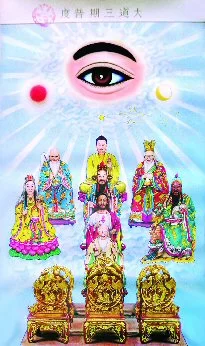
Having asked Cao-Đài for permission to worship him in a tangible form, he received the order to represent him by a symbolic eye.
Such was the conversion of the first Caodaist to the new religion which, six years later, was to be established in Saigon. Soon, Phu Chiêu's administrative duties called him back to the capital, where he won some proselytes to the new Faith. But let us leave for the moment these first converts to show readers how the Grand Master recruited his mediums.
It was in the middle of the Ất-Sửu year (1925). A small group of Annamite secretaries belonging to various administrations in Saigon, relaxed every evening by practicing spiritualism. They used the "rapping table" for this purpose. The first attempts were mediocre. But with patience and training, they obtained positive results. To the questions asked to the Spirits, either in verse or in prose, they received surprising answers. Their deceased relatives or friends manifested themselves to talk about family matters and at the same time advise them on self-denial. These sensational revelations thus taught them the existence of an occult world.
However, one of the communicating Spirits was particularly noticed for its assiduity and its teachings of high moral and philosophical import. This Spirit, who signed under the pseudonym "AAA", did not want to reveal himself, despite the prayers of those present. Soon, other Annamite secretaries joined this small group of amateur spiritualists. The sessions then became more serious and more regular. As the use of the "rapping table" was not convenient, the Spirit in question had it replaced by the "beaked basket". With this device, which allows direct writing, communications naturally became faster and less tiring for the apprentice-mediums.
On December 24, 1925, on the occasion of Christmas, the guiding Spirit, who had until then stubbornly remained anonymous, finally revealed himself to the neo-spiritualists as "the Supreme Being" coming under the name of Cao_Dài to teach the truth in the land of Annam. Speaking in Annamite, He essentially said:
"Rejoice in this celebration. It is the anniversary of my coming to Europe to teach my doctrine. I am very happy to see you, O disciples full of respect and love for me! This house of one of the mediums will have all my blessings. The manifestations of my Omnipotence will inspire even more respect and love for me..."
From then on, the Grand Master initiated his disciples into the new doctrine.
Such was the recruitment of the first mediums responsible for receiving divine messages.
Regarding Chiêu, the first Caodaist, the Revue caodaïste (No. 22, March 1933), on the occasion of his disincarnation, provides us with some details.
*/ His childhood
Phu Ngô Van Chiêu came into the world on February 28, 1878, in Binh-tây (Cholon-ville), in a modest house located behind the pagoda dedicated to Quan-Dê, the Chinese Turenne.
At birth, he refused his mother's breast, who had to give him, instead of natural milk, rice broth.
His parents, who were very poor, later settled in My-tho and entrusted him to his aunt, who sent him to school. Gifted with a keen intelligence, he soon made a name for himself, and at the age of twelve, he presented himself to the Administrator of the province of My-tho to request a scholarship, which was granted to him. Admitted as a boarding scholar, first in the primary cycle, then in the complementary cycle of the Collège de My-tho, he worked diligently and successfully passed the government secretary competition. For the time, this coveted position was the culmination of Franco-indigenous complementary studies. Then twenty-one years old, the young man was content with it, for lack of being able to pursue his studies further, and to help his parents.
*/ His life as a civil servant and his religious vocation.
The novice civil servant was assigned to the Immigration Service in Saigon. He spent three years there, from 1899 to 1902. Having a natural inclination for religious matters, he loved to tell stories of saints and adventures of immortals from ancient China that he had heard narrated by Chinese comrades when he was with his aunt, who was married to a Chinese man. One day, one of his friends caught him telling a story of saints to small Chinese students from Cho-lon, to whom he gave private lessons every evening. He had great respect for genies and saints. At home, he had set up an altar in honor of Quan-Thanh Dê-Quân. He often recited the "Minh-Thanh-Kinh," a prayer book authored by the Spirit of this great general, who was also a man of high virtue, and fasted two days a month.
In 1902, during a spiritualist session that took place in Thu-dâu-môt, where he was present, a superior Spirit manifested and, after revealing his upcoming religious mission, exhorted him to practice the Dao without delay.
If we consult the Revue illustrée, which has undertaken a series of articles on the different religious manifestations in British India, Siam, China, Japan, the Philippines, etc., we find in No. 2 of March 1933 a study on Caodaism in Indochina. We read about its origins:
"Of recent date (1929), Caodaism has rapidly gained momentum and spread throughout Cochinchina.
Origin. - In early 1926, a few young Annamite scholars, all Buddhists, gathered in a "compartment" located in the heart of Saigon. They used to "turn" the table and engage in spiritualist experiments.
However, after a period of trial and error, they eventually obtained "surprising" results, they said, by using comrades possessing a powerful "fluid."
They were initially in spiritual communication with sages of Chinese antiquity, Ly-Thai-Bach, more commonly known as Le-Tai-PE, the Chinese Homer, who revived literature under the 13th Tang dynasty (713-742) and was a fervent Taoist."
Thus, once again, our subtitle appears justified: Caodaism or Annamite Spiritualism.
3/ The Pope of Caodaism
The conversion of Mr. Lê Van Trung, who was to become Pope of Caodaism, was one of the great events in Indochina:
It was also in 1925, Mr. Lê Van Trung lived in Cholon-ville. Engaged in various enterprises, in the tumult of this city dedicated to the worship of money, his mind was completely alienated from religion. One evening, at the invitation of one of his relatives, a convinced spiritualist belonging to a religious sect called "Minh-Ly" (1) in Saigon, he went to a mediumistic session that was to take place in the suburbs, in Cho-gao.
At this meeting, it was the Spirit Ly Thai Bach who manifested. Taking Mr. Trung aside, He revealed his spiritual origin to him and at the same time announced his upcoming religious mission. He then exhorted him to immediately submit to the regime imposed by the new faith. Touched by grace, Mr. Trung changed his life without hesitation. Supported by his faith, he had the courage to immediately stop smoking opium and follow the vegetarian diet; he also abandoned his businesses to devote himself entirely to religion.
The conversion of this man, who until recently was so attached to the possessions and pleasures of life, is so striking that one might wonder if the spiritualist sessions organized until then in Cho-gao had not been inspired by missionary Spirits with the sole purpose of bringing Mr. Lê Van Trung back to the path of the Law. Indeed, when he resolved to live according to the new faith he had embraced, they ordered the dispersion of the spiritualist group, to the great astonishment and deep affliction of its members.
In Saigon, the Grand Master, judging the time had come, brought his mediums closer to Mr. Lê Van Trung. He then sent two of them (Messrs. Cu and Tac) to the new convert, with orders to organize a session there during which he would give him instructions.
- Trung, who did not know these mediums, nevertheless accepted their proposal when he learned the reasons for their approach.
An evocative session took place. The Grand Master, among other teachings, expounded to Mr. Trung his great upcoming mission in the new religion he was about to found to save humanity.
This revelation confirmed the allusions in the various spiritualist messages Mr. Trung had received in Cho-gao with other mediums. It strengthened his conviction and encouraged him to devote himself unreservedly to religious practices.
Some time later, the Grand Master sent Messrs. Trung, Cu and Tac to phu Chiêu, who was to guide them in the religious path as an elder brother. The latter, who had, for his part, been instructed by the Grand Master, gave them the most cordial welcome. He immediately put them in contact with his first co-religionists. The Caodaist core was thus formed, comprising a dozen members, all of French culture and employed, for the most part, in various administrations in Saigon.
The fervor and selflessness of these early pioneers soon attracted an increasing number of adherents. The Caodaist religion then emerged from its restricted circle to spread among the people at the beginning of the year Binh-Dan (1926).
- phu Chiêu, accustomed to solitude, was bothered by the influx of followers, which worried him. A civil servant conscious of his duties, he resolved to keep himself apart from this great religious movement from then on. Mr. Lê Van Trung was then designated by the Grand Master to replace him towards the end of April.
*/ The first oratories
. The spiritualist sessions continued to be more and more numerous in private homes, and mainly in the oratories organized in each of the following centers: Cholon-ville, Cần-giuộc, Lộc-giang, Tân-dinh, Thủ-đức and Cầu-kho. Two mediums were assigned to each oratory to receive the teachings of the Grand Master. The admission of new adherents was also decided there. Adhesions came in masses; they even amounted to several hundred new registrations at each session.
*/ The official declaration of Caodaism
The new religion spread very rapidly, so enthusiastically was it received, especially by the people. Anxious to act openly and to keep within the limits of the strictest legality, its leaders made an official declaration signed by 28 people, which they addressed on October 7, 1926, to the Governor of Cochinchina. Attached to this declaration was also a list of adherents comprising the signatures of the 247 adherents present at the ceremony that consecrated the official existence of Caodaism.
*/ Propaganda.
After making this declaration, which the local Government had received courteously, the leaders of the "Great Way" organized propaganda missions in the interior.
There were three of these, one for the Eastern Provinces, one for the Central Provinces, and one for the Western Provinces.
In less than two months, more than 20,000 people, including many indigenous dignitaries, converted to the new religion. It was thanks to spiritualism, and especially to the infinite goodness of God, who always manifested at each invocatory prayer and whose messages had a decisive influence on those present, that Caodaism owes these mass conversions.
This great success is also due to the form of the new worship, which is not contrary to those of the main religions practiced in the country.
*/ The feast of the advent of Caodaism.
From the 10th day of the 10th month (November 14, 1926), propaganda tours were interrupted. All efforts of the leaders were concentrated on the festival of the advent of Caodaism. This took place on the 14th, 15th, and 16th of the 10th month of the Binh-Dân year (November 18, 19, and 20, 1926) in the Tu-Lâm-Tu pagoda, located in Go-ken (Tây-ninh). The Governor-General of Indochina, as well as the Governor of Cochinchina and high-ranking European and indigenous officials, were invited.
Celebrated with solemnity, this festival gathered a considerable number of adherents who flocked from all the Provinces of Cochinchina. It also attracted thousands of laypeople who came as curious onlookers as well as observers. The presence of Mr. Captain Monet, a great French spiritualist, was also noted.
It was during this festival that the Caodaist Priesthood was instituted and the new religious Code was established and promulgated.
*/ The definitive seat of Caodaism.
The Tu-Lâm-Tu is a Buddhist pagoda newly built by hoà-thuong Giac hai from Cho-gao (Cho-lon), who had assigned it to the new religion to which he had been converted. But after the festival, the Buddhist faithful who had provided the funds for the construction of this temple and who had not been consulted on its disaffection, demanded its return to its original purpose.
On the other hand, experience had shown that this pagoda was too small and that the land on which it was built was too cramped to properly install the Seat of the nascent new religion, destined for a great future.
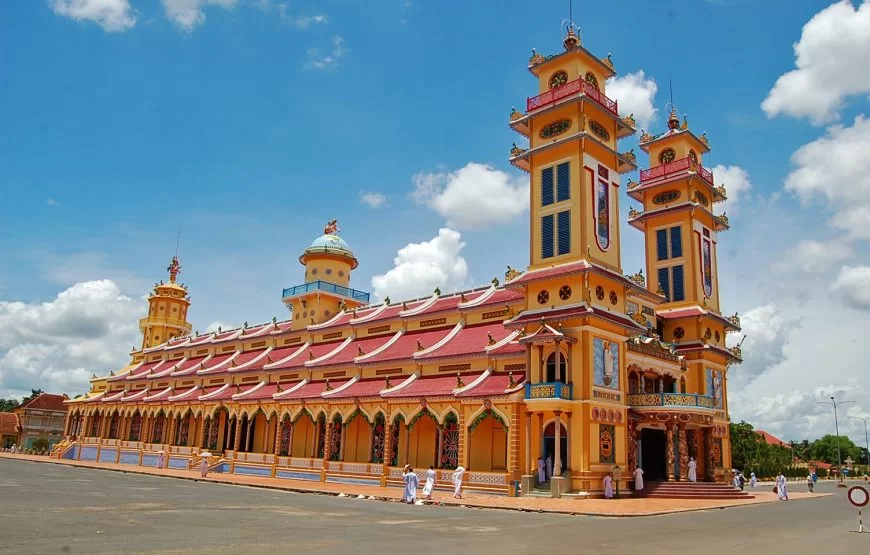
Upon the indications of a superior Spirit, the land on which the provisional temple currently stands was therefore chosen and purchased to definitively establish the Caodaist Holy See there. Located in the village of Long-thành, Tây-ninh province, it is large enough (approximately 100 ha) to meet current and future needs.
| * If this article is interesting and useful, please share it with your Friends and people around you by choosing the sharing channel below! * If you wish to travel to Vietnam and truly discover it in depth with the most authentic places and the most typical cultures, we suggest you take a tailor-made trip to your wishes with a French-speaking travel agency in Vietnam like Typic Travel. Click our "Free quote" or "Tailor-made trip" button or send an email to Typic Travel * If you are simply looking for travel ideas in Vietnam or Indochinese Countries, Typic Travel offers some main ideas according to the category of our trips on "idea of our trips" or follow us on one of your social networks to get more permanent information: |
|
Follow us on:
|
TripAdvisor | Facebook | Petit Futé | Youtube | Twitter | Instagram
|
