

Ancestors worship
The cult of ancestors: it constitutes the oldest religious practice in Vietnam, predating Buddhism and Confucianism. Vietnamese people believe that the souls of their parents survive after death and protect their descendants.
Ancestor worship is an essential component of Vietnamese culture that plays a vital role in the daily lives of individuals and society. We consider it one of the pillars of Vietnamese culture and a striking difference from Western customs, which is why we wish to elaborate on it here.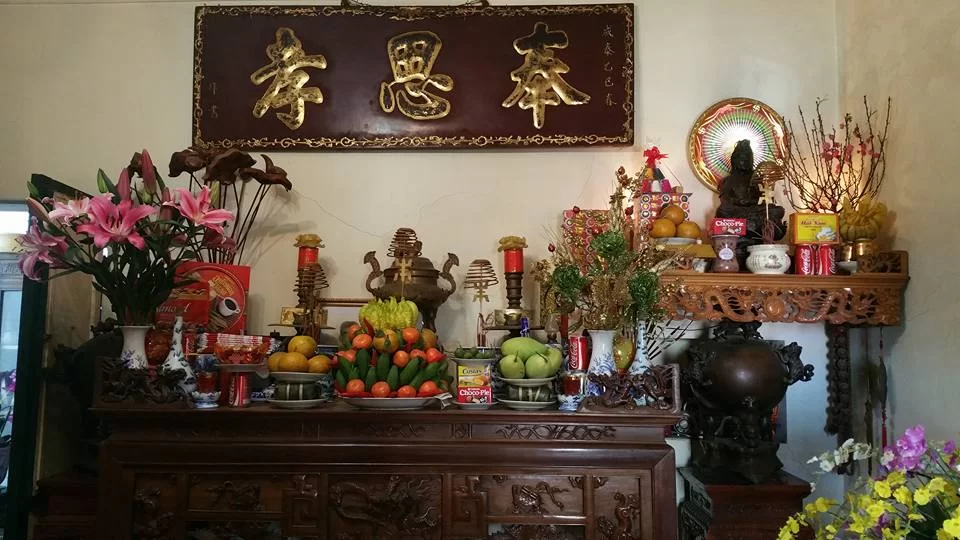
Liêm (2002) sees this worship as a process that "establishes individual identity in relation to time, family, and real and symbolic, private, sacred, and public spaces where one lives and evolves." Nguyên-Rouault (2001) considers it "a factor of uniqueness, social and family cohesion, among a people who have successfully reconciled extremely varied religious, philosophical, and political influences."
She adds that it constitutes "the very foundation and essence of Vietnam's traditional family structure and continues to inspire it today. Respect for ancestor worship clearly contributes to the cohesion of each family and the regulation of intergenerational relationships. A family and intimate cult, it is and remains the foundation and essence of Vietnamese culture, the link between all Vietnamese people from north to south of the country, of all social origins, of all religious confessions."
Here we see that the scope of ancestor worship touches both the individual, their group, the past, the present, and a large number of traditions shared by Vietnamese people for dozens of generations. It binds the individual to their ancestors through a feeling of affection, respect, and gratitude, as well as to their clan, which will be united by the same solidarity.
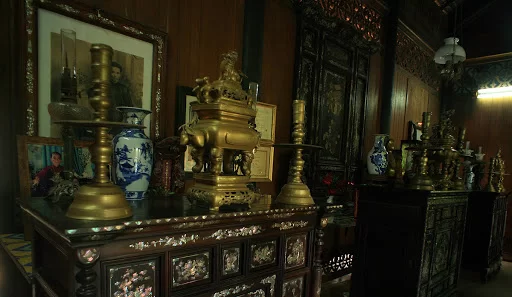
Ancestor worship is an extension of filial piety, and in these two traditions, we find the same moral foundation, namely the respect of the younger generation for their elders. Filial piety unites living generations, while ancestor worship perpetuates the attitude that children have had throughout their lives towards their ancestors, and now with their deceased ascendants: "To venerate ancestors is above all to venerate the beings who gave us birth, life, existence."
Ancestor worship appears as an ancestral traditional belief, which although "practiced long before the introduction [of] religious and moral precepts into Vietnamese religion"1, today appears as a "synthesis of ancient animistic and Confucian beliefs and experiences"2, bringing together within the family, in a syncretic way, religious doctrines (Buddhist, Catholic, Protestant...), Taoist precepts, as well as Confucian foundations. It is based on the belief that the real and invisible worlds are never totally separated from the afterlife, and that relationships between living beings and the supernatural exist permanently. Also, still according to this belief, there is in Vietnamese culture the conviction that the souls of the deceased survive after death, protect their descendants, hence the importance of organizing commemorative ceremonies for them.
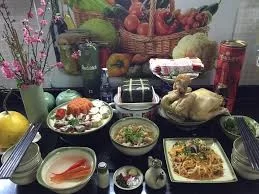
Ancestor worship takes place from the first day of death and plays a particularly important role in the months that follow because it allows a smooth passage of the deceased's soul from the visible world to the invisible world of ancestors. It will take place during any particular family event (Tết holiday, birth, marriage, children's birthdays, competitions, house construction, illness...), but also throughout the year: family members "continue to live with their descendants, they are kept informed and associated with every important event (...) [and] in a completely natural and harmonious way, the world of the dead and that of their descendants are thus reunited in all homes in Vietnam and the diaspora."
The ancestor worship ceremony, and the "Dam giô4" in particular, will bring together people "recognizing a kinship link between them." This notion of connection is paramount in Vietnam because it represents a true component of each individual's identity. "It is this connection that allows one to manifest oneself, either orally to express interest and filiation, or concretely by coming to the celebration when conditions permit. It is an event of convivial solidarity where the deceased (their symbolic presence) is invited to return home to share a meal with their loved ones, and to attest to the fidelity of the bond between everyone"5.
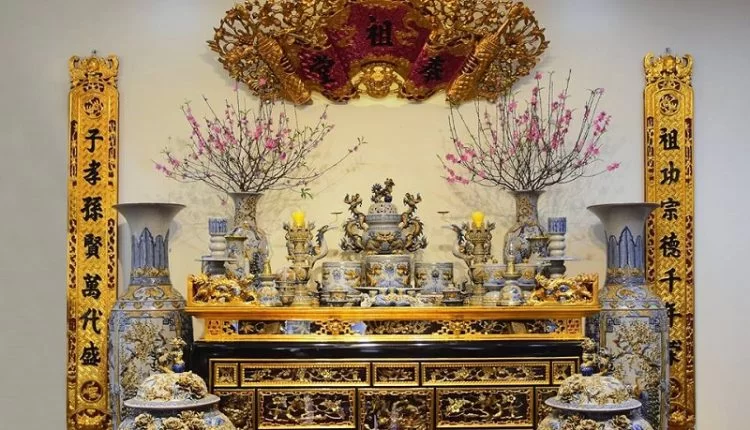
The family community is therefore much broader than the nuclear family, and within the clan family, the notion of cousin/uncle/aunt often extends far beyond the framework usually considered in the West. The lineage in relation to common ancestors, sometimes going back more than four generations, creates among members of the same clan a strong sense of belonging and solidarity in the face of life's challenges, which has led to the comparison of ancestor worship to a "family religion".
Ancestor worship aims to honor the memory of deceased relatives or at least the last vanished generations, it being understood that the family has regularly practiced the cult throughout history and that it is therefore not necessary to honor the entire pantheon of the family's deceased. Also, not all deceased persons are honored in the same way: "if the living occupy a higher rank in the family hierarchy than the dead, they are not obliged to practice the cult; thus a person will scrupulously respect the ancestor worship dedicated to their parents but, generally, will not respect it towards their deceased child"1. Hierarchy therefore retains a strong influence also in the invisible world.
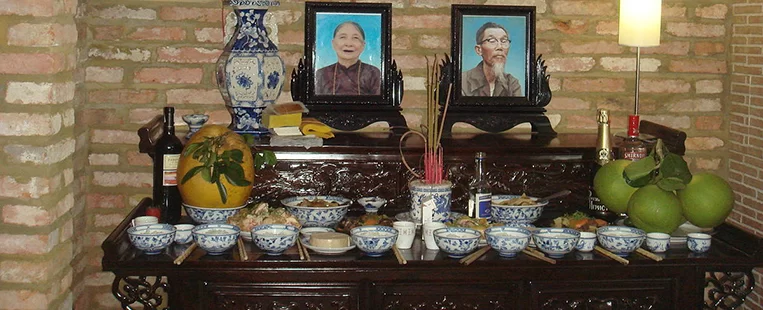
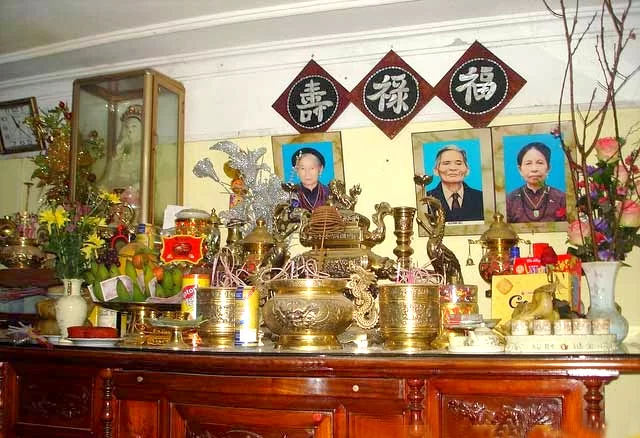
Ancestor worship is organized primarily around the ancestor altar which is present in most Vietnamese homes, in the most "decent" place in the house, generally located in the highest position. A photo of the last deceased is placed in the center of the altar, sometimes replaced by an engraving, a drawing or just a sign bearing the names of the deceased. Photo montages sometimes allow old photos to be colorized or retouched to bring several ancestors together around scenes of daily life. Around these portraits, representations of Buddha, Jesus or any other person the family wishes to honor may also appear. Numerous incense burners with incense sticks, flowers, and any other object that can decorate and enhance the rituals are also placed.
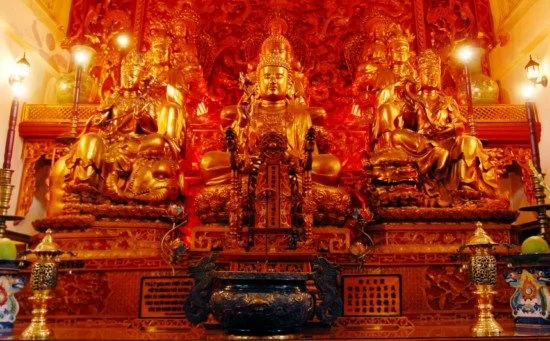
During ceremonies, food and offerings (incense, cigarettes, alcohol, etc.) will be served on the altar around three place settings: one for the returned deceased, and two others for his possible travel companions who would accompany him. Offerings appear as an essential point of the rite because they symbolize an exchange between the living and the ancestors, and the quality of the gift will then reflect the measure of expectations. During the procession, each guest will greet the altar, bowing or kneeling, and all the dishes shared by the guests as well as rice wine and tea will be served. By prostrating themselves, the head of the family, generally the eldest son, and all other members wish
"welcome to the ancestors and express their joy at finding them again. (...). The presence of ancestors is therefore a natural and happy element of family life".
This symbolic meal once again highlights Vietnamese spirituality and represents a very strong symbol in the culture. We will return to this idea when we are interested in finding a reference scene specific to Vietnam.
Also, if the importance of ancestor worship is undeniable in the organization of the Vietnamese family and society, Liêm (2002) identified different singular characteristics that could have a precise role in the psychology of each individual.
According to him, the mourning ritual, thus spread over several stages and involving numerous rituals, "gradually transposes the pain of losing a loved one into the memory of each person and organizes collective memory as a shared private reference". This process would then allow "to keep one's dead" and "considerably prevent depression as the psychological reaction to a total and definitive loss of the other's presence. The pain is shared".
The presence of the ancestor altar in the home would also make it possible to maintain contact with the invisible world and a proximity to death which, with appropriate explanations, would allow "children's anxiety about time and death to take on another appearance: it is the internalization of what will happen to everyone and in order (death), and the perpetuation of transmissions will ensure a kind of eternity of Being after having existed.
Each person accesses the sacred. This presence is a pretext for family stories and life stories useful for education, especially character education".
Ancestor worship would also maintain Vietnamese values, particularly in relation to intergenerational psychology: "respect for generations and recognition of filiations, importance of the sacred in the domestic symbolic space, structuring function of ethics, consideration of the temporality of acts of birth and death. The person, even the child, can take the ancestor as a witness for any subject: they come to express themselves aloud (or softly) before the altar, a sacred place par excellence that benefits from definitive immunity".
The ancestor altar would then also have a role as a confidant, a receptacle for moods or states of mind, structuring and regulating potential intergenerational conflicts by displaying the rules accepted by the family and society.
The practices of ancestor worship would then be the guarantor of biological filiation and the filiation of memory practices. Having reached adulthood, children "will have to prove their sense of duty, responsibilities, and their ability to ensure the reproduction of respect due to the elderly, to the dead, and thus to memory, to the past," making the feeling of filial piety a true "very foundation of their personality."
Nguyên Khac Vien, a perpetual visionary, also imagines that the importance of ancestor worship is such that it may have an important role to play in the future to moderate modernization and preserve traditions: "The nuclear family, which tends to become the predominant modality in urban areas, in Vietnam as in other countries, is subject to the influence of various centrifugal forces. Can ancestor worship continue to play a stabilizing role? Is it destined to persist durably or will it disappear in the near future? If it endures, what new forms will it take? Is it necessarily linked to the existence of the extended family, of the lineage? Does this kinship depend on a determined techno-economic structure, and therefore condemned to disappear in a new economic system?"
Finally, let us note that, as Liêm (2002) believes, ancestor worship, integrating more broadly into general Confucian philosophy, can also lead, if applied as an "authoritarian reference," to a "source of abuse of power in the family, also a source of docile submission in a society envisioned as a large family."
What can be retained regarding popular beliefs and practices in Vietnam
In Vietnam, there are a great number of beliefs related to supernatural representations through genies and other immaterial forces that maintain reciprocal relationships with the human world. In light of this, there are many practices aimed at communicating with the invisible world to solicit its generosity, ask for its advice, or implore its forgiveness.
Also, in a general way, it appears that Vietnamese people attach great importance to myths and the magical dimension, and that they will be particularly sensitive to symbolic representations and traditional practices. The dominant place that men hold within the Vietnamese family is linked to Confucian rules (transmission of the name, perpetuation of the lineage, ancestor worship ceremonies, etc.) and contributes to maintaining an idealization of the male sex and, conversely, a possible devalorization of the female sex. The fact that families usually gather three or four generations under the same roof with the extended family (grandparents' siblings), with a specific place for each person (the weight of hierarchy, education, teaching of politeness and good manners often falling to the grandmother, potential conflicts between the mother and her mother or mother-in-law regarding the proposed education, etc.), requires the psychologist to particularly investigate family relationships and organization. The psychologist must also take into account traditionally instilled types of education, often permissive at first for boys (child-king) then progressively marked by a respect for authority demanding obedience and good school results, while girls will often be more quickly involved in domestic tasks and caring for siblings.
Finally, ancestor worship, a fundamental practice in Vietnam linking the present with the past, and providing an identity and a set of values to all members of the clan, is very important in the daily lives of individuals (offerings to honor ancestors and bring prosperity and luck to the home, involvement of ancestors for all important life events (birth, marriage, etc.)), and plays a fundamental role in the organization of the family and Vietnamese society as a whole. This practice also seems to us to be a symbol bringing together a large number of Vietnamese cultural factors that a foreign clinician must perceive if they wish to work with this culture.
* If you are interested in this article and find it useful, please share it with your friends and the people around you.
* If you wish to travel to Vietnam to discover all its beauty and cultural charms with a 100% customized trip, the TypicTravel agency, a local expert, offers to create a tailor-made trip according to your wishes.
* If you are looking for travel ideas, Typic Travel would like to propose some main ideas according to our travel categories:
- Must-see Trips
- Off the Beaten Path
- Hiking - Trekking
- Multi-Country Combinations
- Family Trips
- Themed Trips
- Photo Tours
- Deluxe Trips
- Honeymoon Trips
- Culinary Trips
- Cruises & Holidays
- Beach Stays & Short Tours
- Popular Trips
- Heartfelt Novelties
You can send us an email by clicking HERE or follow us easily on our social networks for permanent updates:
| Follow us on: | TripAdvisor | Facebook | Petit Futé | Youtube | Twitter | Instagram |
