

The wedding of Viets
The concepts of marriage differ according to historical periods or regions of the country. The rites are also not the same for the 54 ethnic groups, given their cultures and lifestyles. Here, we attempt to present only the marriage of the Viet, the main ethnic group in the country (85%), which has been largely influenced by Chinese culture.
Concepts of marriage differ according to historical periods or regions of the country. The rites are also not the same for the 54 ethnic groups, given their cultures and ways of life. Here, we attempt to present only the marriage of the Viet, the main ethnic group in the country (85%), which has been largely influenced by Chinese culture.
1/ Marriage in Vietnam
For more than a quarter of the 20th century, Vietnam evoked a series of wars for the whole world. In reality, with a history spanning over 4000 years and a population composed of 54 different ethnic groups, Vietnam possesses a very rich culture. Hundreds of books and research, in Vietnamese and even in foreign languages, can be found on this intangible heritage. Nevertheless, there is a subject that has so far been "forgotten" by specialists: that of marriage. Perhaps because it is considered a procedure that anyone wishing to start a family must necessarily go through, marriage has become something "everyday," "without particular interest." In reality, a traditional Vietnamese marriage includes several stages and rites, unknown to most young people, but which are part of Vietnamese cultural identity.
Trends of returning to historical and cultural roots encourage people to become increasingly interested in the customs and traditions of their country. Marriage, with a special meaning in a couple's life, has a clearer importance and a predominant role in the cultural heritage treasure.
2/ The Viet Marriage
Concepts of marriage differ according to historical periods or regions of the country. The rites are also not the same for the 54 ethnic groups, given their cultures and ways of life. Here, we attempt to present only the marriage of the Viet, the main ethnic group in the country (85%), which has been largely influenced by Chinese culture. Information on marriage among ethnic minorities can be found in Pham Minh Thao's book.
*/ The role of parents
In the past, parents had full power in all matters concerning family life. It was they who decided on the choice of partners for their children. In general, parents wished (and still wish) to find a good family, of the same standard of living as theirs (or better), whose son or daughter, well-educated, would make a perfect life companion for their offspring. It often happened that the bride and groom did not know each other before the wedding. In this case, a matchmaker served as an intermediary between the two families.
To ensure the happiness of young couples, and especially their own children, parents displayed certain criteria in choosing spouses:
*/ The bride:
To be a perfect wife, a young girl must possess the four virtues Cong, Dung, Ngon, Hanh.
Công - housework: In a Confucian society, young girls are expected to perform all domestic tasks, including sewing, embroidery, weaving, knitting, raising animals (poultry, livestock...) with flawless speed and efficiency. The wise said, "One becomes rich with the help of friends and honorable thanks to one's wife." That is why a woman was considered a general of the interior.
Dung - beauty: Despite the saying "Virtue triumphs over beauty," no one wants a deformed wife or one with an unpleasant appearance. Parents wished to find a healthy daughter-in-law to ensure the continuation of their lineage.
Ngon - speech: The woman in ancient society had no say in matters. In addition, she had to obey her husband as well as her parents, choose the right words, and be polite to everyone.
Hạnh - good conduct: Outside her own family, the good wife was obliged to take care of elderly parents and be on good terms with all members of her in-laws.
*/ The groom:
The young man had more luck than the young girl; he would only be asked for courage, good conduct, and intelligence if possible (this last criterion was unimportant in the case of peasants and people from modest families).
Tam thu, luc le - The three letters, the six rites
According to ancient Chinese customs, marriage was organized in several stages with "the three letters and the six rites." The three letters are letters written by the fiancé's parents and addressed to the fiancée's family throughout the marriage preparation period. The six rites constitute the marriage ceremonies that young people must go through to become spouses.
In the context of feudal society, the matchmaker plays an important role in the relations between the two families. She is the one who inquires about the girl's family, about the girl herself, and reports the collected information to the young man's family. If the girl is chosen, the young man's parents will entrust the matchmaker with expressing their intentions to the future in-laws. From then on, the matchmaker delivers a first letter that serves as an introduction, expressing the young man's family's intention to forge closer relations with the girl's family. With the consent of the fiancée's family, the young man's family arrives on a date pre-arranged by both sides. This is the first rite, the Nap Thai or Cham Ngo, where the groom's family brings the ritual wedding presents to the bride's home.
The second rite is the Van Danh, the name exchange ceremony before the engagement. The groom's family chooses an auspicious day and once again resorts to the matchmaker to bring presents, accompanied by a second letter, to the fiancée's family to ask for the girl's first name, last name, and date of birth. The presents generally consist of tea, wine, pastries, betel leaves, and areca nuts. The parents consult the horoscope and decide whether the two young people are made for each other or not.
At the Nap Cat, the third rite, before the altar, the two families inform the ancestors that the young people can form a beautiful couple and are ready for marriage.
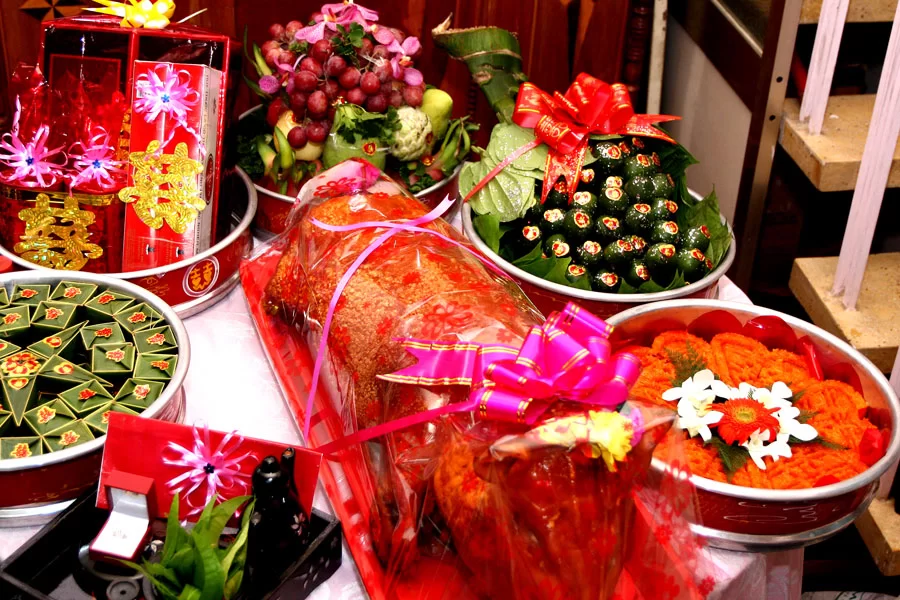
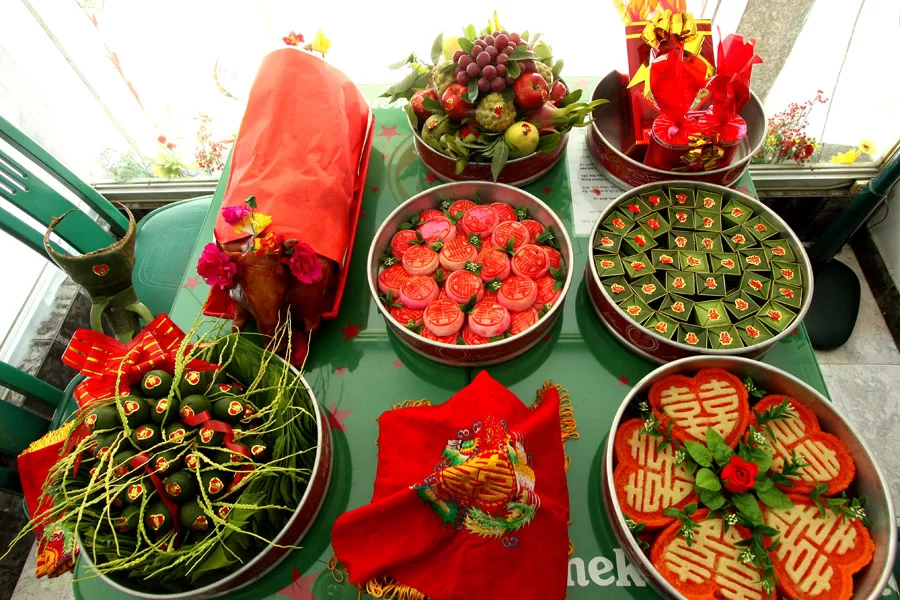
The fourth period arrives with the Nap Trung, or the engagement. In addition to the ritual presents already mentioned, jewelry for the bride, a pair of red candles engraved with a dragon (symbolizing the groom) and a phoenix (for the bride), and a sum of money are added. The presents are placed in round red lacquered boxes; the number of these boxes must be an even number. The two candles will be lit and placed on the ancestral altar at the beginning of the ceremony. The money represents the groom's family's contribution to the bride's personal purchases and the banquet organized on this occasion.
The third and final letter will be addressed at the Thinh Ky, the fifth rite, where the groom's family requests confirmation of the chosen day and time for the main ceremony, the wedding. Presents such as tea, wine, and pastries accompany the letter.
Finally, the most solemn and important rite of all arrives: the Than Nghinh or Vu Quy, which is the wedding itself.
*/ The wedding ceremony
The more solemnly the wedding is organized, the deeper and more lasting meaning it will have in the lives of couples. Solemn does not mean costly or "demonstrative". The main objective is to conform to morality by preserving the family's educational traditions.
The wedding ceremony consists of five stages:
*/ The official ceremony at the bride's home
-/ The Ruoc Dau (the ceremony where the bride is led to the groom's home)
-/ The official ceremony at the groom's home
Complementary ceremonies such as the To Hong (according to Chinese customs, this rite has long been forgotten and abolished in Vietnam), the Giao Duyen (exchange of greetings between the newlyweds on the wedding night)
The Phan Bai or Lai Mat (the first visit of the newlyweds to the spouse's family)
The official ceremony at the bride's home. Unlike the official ceremony at the groom's home, at the bride's home, it takes place over two days. The first day is reserved for the Nhom Ho, where all members of the bride's family gather to meet her before she leaves to live her new life. Those living in other provinces are also summoned. The parents and elderly members of the family give advice to the bride on what she should or should not do on the wedding day, as well as during her married life.
After the meeting, a banquet is organized on this occasion, and friends and neighbors are invited to celebrate the event with the family. In front of the house, an artificial dome of foliage is erected, on which a small beautifully decorated board with the two words Vu Quy (which means that the bride goes to her husband's home on the wedding day) is hung to announce the happy occasion to everyone. Guests bring gifts or money to the newlyweds. If the groom lives in the same city or province, he can be present on this day.
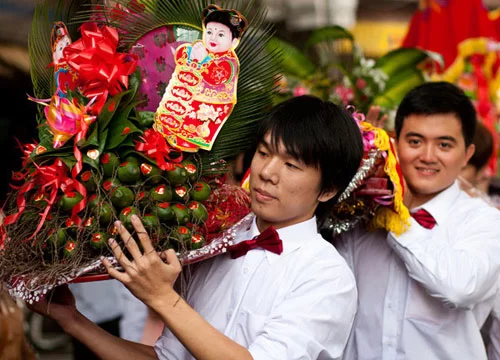
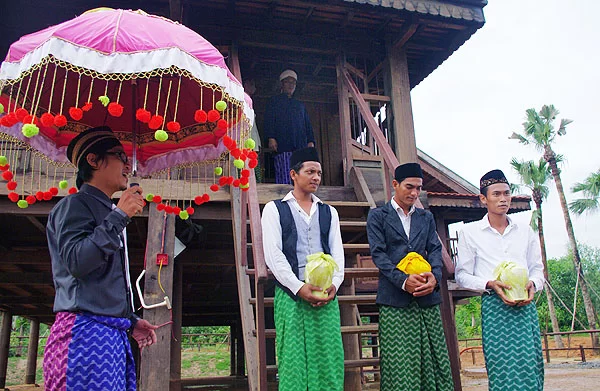
On the morning of the second day, at the appointed time, the groom's family delegation arrives at the bride's house, carrying red lacquered round boxes full of presents such as betel leaves, areca nuts, wine, pastries, five kinds of fruits, a pair of candles... According to tradition, they stop a few meters from the house. Firecrackers crackle to welcome the arrivals (for safety reasons, firecrackers have been banned for about ten years). Then, an elderly person and a friend of the groom (or one of his brothers) step forward and present the tray of betel leaves and wine to the bride's parents. This ritual serves to announce that the time has come to take the bride to the groom's house.
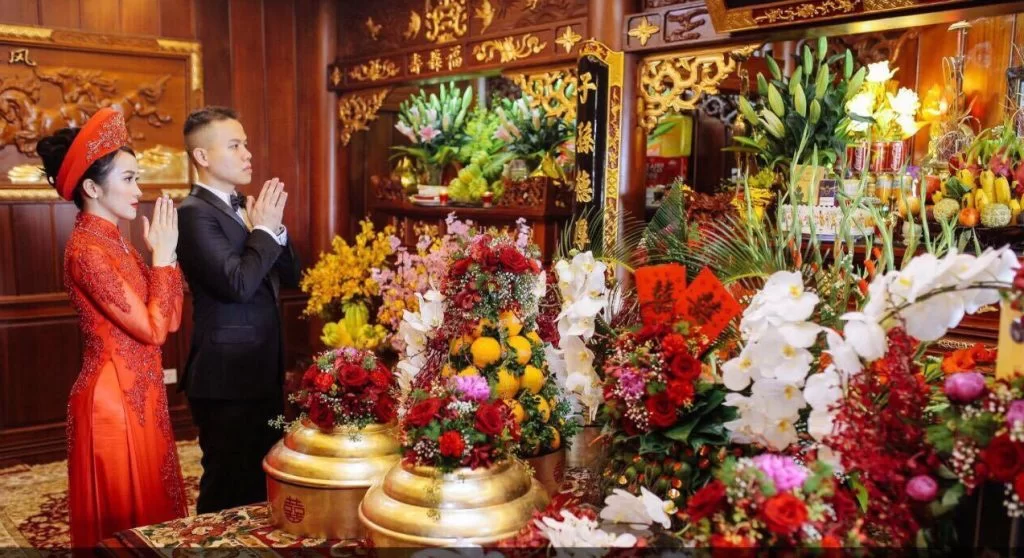
In the courtyard or in front of the house, the ritual of exchanging gift boxes between the two families takes place. Generally, on the groom's side, young men carry these boxes and hand them over to young women on the bride's side. All the boxes will then be placed on a table in front of the ancestors' altar. On this day, the altar is beautifully decorated with flowers and fruits; sometimes small sculptures of fresh fruits in the shape of dragons and phoenixes are also made.
Meanwhile, the groom stands in front of the altar, holding the wedding bouquet in his arm. His family is invited to stand to the right of the altar; the bride's family will be on the left. The groom's family is given the floor to begin the ceremony. If the matchmaker is present, it is her role to be the intermediary. The bride's family will respond. The words and phrases must be carefully chosen and represent the solemnity of the occasion. The members of the two families present are then introduced.
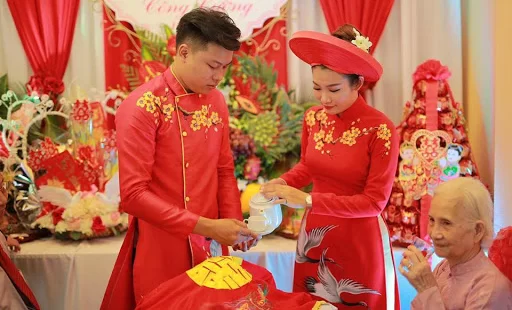
During all these rituals, the bride remains inside, in one of the closed rooms, adorned with a red or pink voile curtain. When it is time for her presentation, the bride comes out of the room, bows slightly to greet both families and will be accompanied by her mother to the altar, next to the groom. Then, he offers her the wedding bouquet and the ritual of lighting candles on the altar proceeds, as at the engagement ceremony. The bride's father burns incense and invokes the ancestors as witnesses to the ceremony. Afterwards, the groom's mother offers jewelry to the bride (a chain with a medallion, earrings, bracelets, all in gold and possibly inlaid with precious stones). The exchange of rings between the newlyweds marks the moment when the young people are recognized as spouses before the two families.
To conclude the ceremony, the prostration of the newlyweds before the altar is a solemn and very important occasion. This means that they ask the ancestors to bear witness to their will to found a new family, whose head - the husband - assumes responsibility. He commits to guiding and guaranteeing his wife's life until her death.
Ruoc Dau. In the city, cars are used to take the bride to her husband's house. In the countryside, means of transport are different: boats, sampans, ox-drawn or horse-drawn carts... anything is possible depending on local conditions. In all cases, the vehicle reserved for the newlyweds is decorated with flowers, brightly colored ribbons (generally red or pink, or yellow). The cost of transporting the bride's family falls to the groom's family. The bride's sisters or cousins, and friends bring her suitcases of clothes or personal belongings to her new home.
The official ceremony at the groom's house. In principle, the ceremony takes place much like at the bride's house, but of course without the exchange of presents, rings, and jewelry. After the ceremony, the bride rests for a moment, refreshes herself, and offers betel leaves and areca nuts to the elderly members of her in-laws. At noon or in the evening, the groom's parents organize a grand feast in honor of their child's wedding. Some members of the bride's family are also invited.
Giao Duyen. The ritual gesture of exchanging greetings between the two spouses takes place in the nuptial chamber. The husband shares with his wife the betel leaves offered at the ancestors' altar during the morning ceremony, then pours wine into a glass, and the two spouses each drink half.
Phan Bai. Three days after the wedding, the young couple returns to visit the wife's parents. In the North, the spouses bring sticky rice and liquid compote as a present. In the South, this is replaced by wine, tea, pastries, fruits; in some provinces, it will be two ducks.
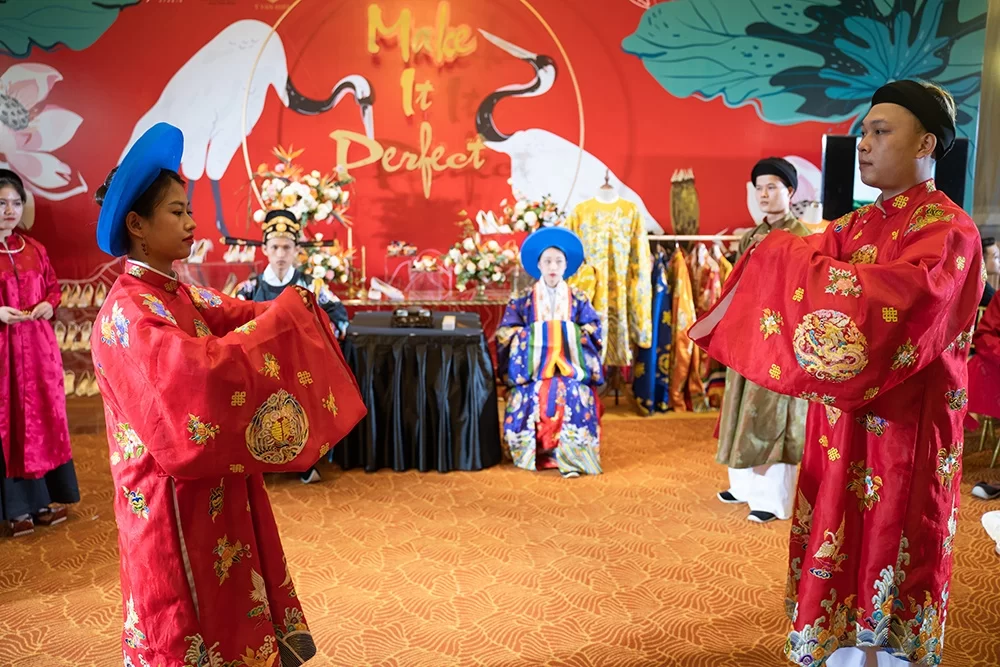
Wedding costumes: In the past, newlyweds had to wear the national costume with variations for each region or province. Today, the groom wears a European suit. Sometimes he wears the traditional "ao dai" at the request of the bride's parents for the ritual gestures in front of the altar. The "ao dai" is preferred by the bride for ceremonies because it highlights the femininity and allure of the wearer. During the banquet, ball gowns or European costumes are more common.
*/ The preservation and promotion of wedding rituals
Acculturation and modernization have contributed to simplifying wedding customs in Vietnam. Currently, three stages remain: Nap Thai or Cham Ngo, Nap Trung or engagement, and Vu Quy or wedding. For some modest families, it is acceptable to combine the last two rites, engagement and wedding, into one day.
The Constitution of Vietnam proclaims that every citizen over eighteen years old is free to marry. This is why the role of parents nowadays is limited to giving consent and advice to their children. The traditional matchmaker, losing her importance, is replaced by agencies or dating clubs.
Despite the changes, Vietnamese people strive to preserve the customs and traditions long established by their ancestors, eliminating backward practices and replacing them with rites more appropriate to modern life. The education of young people implies that parents imbue them with the soul and cultural identity of our people through its traditions.
As part of the country's intangible heritage, marriage has specificities that must be seriously considered by those interested in it. Oral transmission, which helps spread this cultural richness to different layers of the population, makes preservation and promotion more difficult. Mr. Chi Ben Nguyen, a specialist and researcher in the History of Vietnamese Arts and Cultures, states: "One of the solutions seems to be the socialization of these activities (the preservation and promotion of intangible cultural riches - Editor's note by XLVS)... One of the most widespread means is writing, that is, copying and editing. In this regard, we have done many things. Especially for the treasure of folklore... The problem is that, despite the very positive effect of writing and editing, there are still other means, particularly in an era where information and communication technologies are developing at high speed. For example, a series of video-cassette films presenting the festivals of the peoples in Vietnam, on the "heris" (of the Gia Rai), or the "heaumier" (of the Banas) is very necessary and very effective for the preservation of this intangible cultural treasure."
Preserving and promoting traditional Vietnamese marriage for the benefit of tourism is an even more difficult task. How can foreign tourists understand all the nuances of the different wedding rites, the solemnity of the greetings exchanged between the spouses on the wedding night or before the ancestors' altar? A simple presentation is not enough. Could we propose a special tour entitled "Vietnamese Wedding Ceremonies (or Rites)", where tourists could participate in a real wedding, with a knowledgeable guide capable of answering all the questions asked by tourists? Would the publication of a CD-ROM of wedding ceremonies perhaps help to better present this cultural heritage treasure? The answer is reserved for specialists, tour operators, and tourists themselves as the main actors of cultural tourism.
| * If this article is interesting and useful, please share it with your friends and people around you by choosing the sharing channel below! * If you want to travel to Vietnam and truly discover it in depth with the most authentic places and the most typical cultures, we suggest you take a tailor-made trip to your wishes with a French-speaking travel agency in Vietnam like Typic Travel. Click our "Free quote" or "Tailor-made trip" button or send an email to Typic Travel * If you are simply looking for travel ideas in Vietnam or Indochinese countries, Typic Travel offers some main ideas according to the category of our trips on "idea of our trips" or follow us on one of your social networks to get more permanent info: |
| Follow us on: | TripAdvisor | Facebook | Petit Futé | Youtube | Twitter | Instagram |