



Circulation in Vietnam: everything you need to know before your trip to Hanoi
As soon as you leave the airport, Vietnam plunges you into a world apart. Thousands of scooters, intersections without traffic lights, pedestrians crossing without looking, and yet, everything works. What tourists perceive as chaos actually obeys invisible rules, well-practiced by millions of drivers every day. In this article, we explain how to understand Vietnamese traffic, how to cross a street without panicking, and which means of transport to choose for getting around with peace of mind.

VIETNAM
Traffic in Vietnam:
the organized chaos
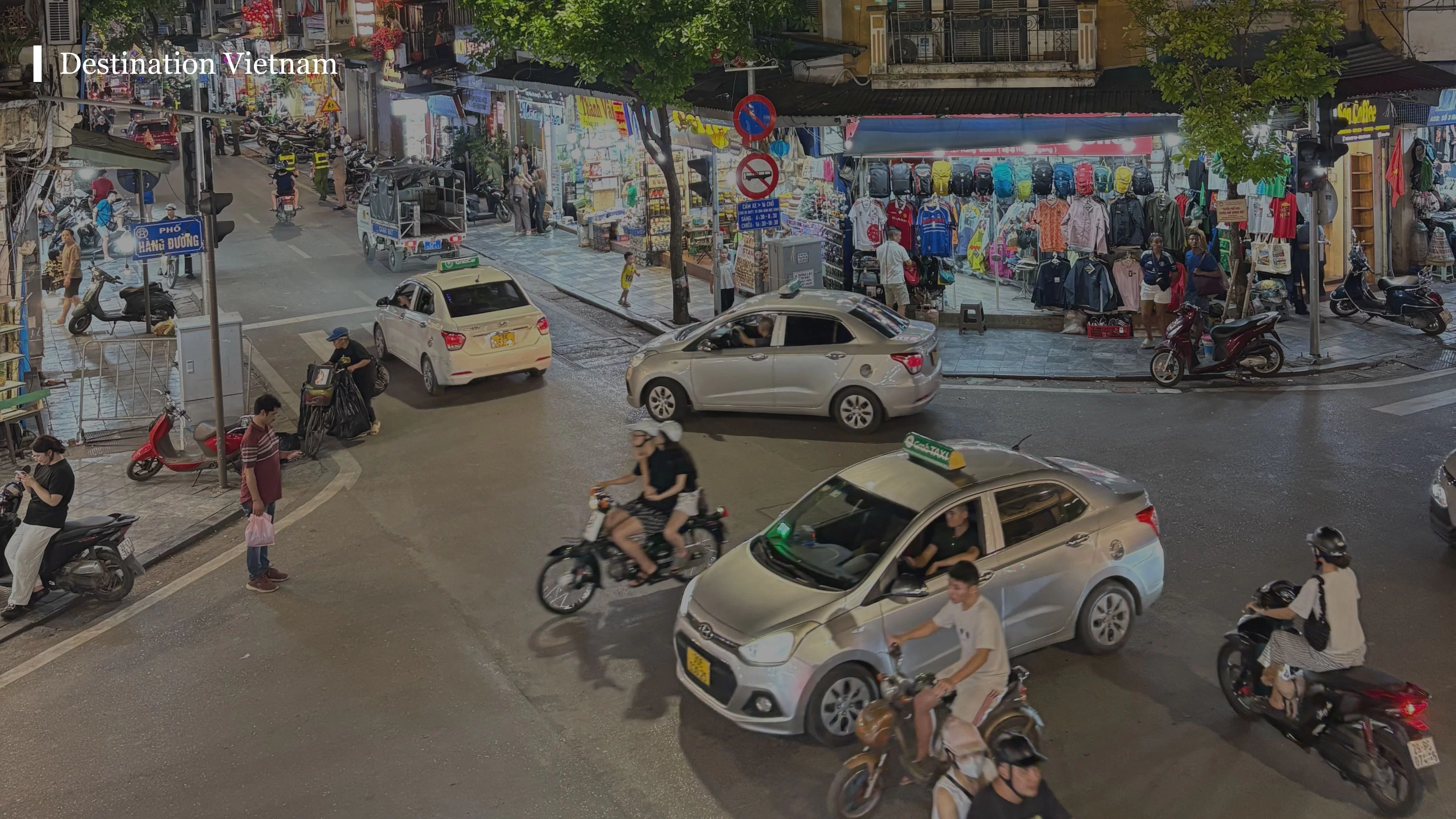
 Intersection in Hanoi's Old Quarter, at night — © Tydiane
The first thing that strikes you when you arrive in Vietnam is the noise. Even before seeing the streets, you hear a continuous flow of engines and horns. Then you see them, and it's hard not to be left speechless.
The intersections of Hanoi at first glance resemble total disorder. Dozens of scooters, cars infiltrating every available space, bicycles weaving through it all, and somewhere in the middle, pedestrians crossing with disconcerting calm. No obvious right-of-way, no traffic lights strictly obeyed. And yet, it moves.
A system with its own rules
What seems chaotic from the outside actually obeys a well-oiled logic. The golden rule of Vietnamese traffic is continuous flow: you don't stop abruptly, you anticipate, you merge gently. Everyone adjusts their trajectory in real-time, based on what others are doing. It's almost a choreography.

The scooter, much more than a vehicle

Scooter parking in the center of Hanoi — hundreds of two-wheelers packed side by side — © Tydiane
In Vietnam, the scooter is not just one means of transport among others; it is THE means of transport. Entire families are transported on it, as are improbable goods and food. It is at once a taxi, a van, and a mobile office. Apps like Grab have simply digitized what already existed: a two-wheeler culture deeply rooted in daily life.
Getting around as a traveler: what you need to know
Crossing a street in Hanoi or Ho Chi Minh City can be intimidating at first, and that's perfectly normal. The key is not to wait for a perfectly clear path, which will never come. You need to move slowly, at a steady pace, maintaining a predictable trajectory. Local drivers are used to going around pedestrians: you need to be readable, they won't stop.

For city travel, Grab (the local equivalent of Uber) is by far the most practical and safest solution for a traveler. The app is in English, the price is fixed in advance, and drivers are used to tourists. Grab offers both cars and scooters.

Grab applications — © Vietnam Airlines
Renting a scooter yourself is possible, and many travelers do it. That said, it requires real driving experience in dense environments, good control of a two-wheeler, and appropriate insurance. It's not a decision to be taken lightly, especially in large cities.
What it teaches you
Living amidst this traffic means accepting to let go of your European reflexes. You don't look for a pedestrian crossing, you don't wait for the green light; you move slowly and trust the collective movement. It's a lesson in adaptation in itself, and perhaps the best introduction to what Vietnam has to teach: here, flow takes precedence, not rigid rules.
Vietnam surprises, challenges, and fascinates — provided you arrive prepared.
And it starts right from the airport exit.
Do you want to discover Vietnam for yourself? The Typic Travel team will prepare a tailor-made trip for you, with all the practical advice for traveling serenely — including on site. Contact us and let's discuss your project. → Plan my trip to Vietnam
Vietnam - organized chaos