


The Ao Dai and its genesis
According to legend, the Two Trưng Ladies wore two-panel golden áo dài, with golden parasols, on elephant-back in battles. Afterwards, to honor them, Vietnamese women avoid wearing four-panel dresses instead of two.
To this day, no one can pinpoint the exact genesis of the áo dài, which has always been intrinsically linked to Vietnamese women. According to archaeologists, the image of the áo dài with two long flowing panels has already been found in engravings on ancient bronze drums from Ngoc Lu, Hoa Binh, Hoang Ha, and on the bronze tower of Đao Thinh, dating back three thousand years.
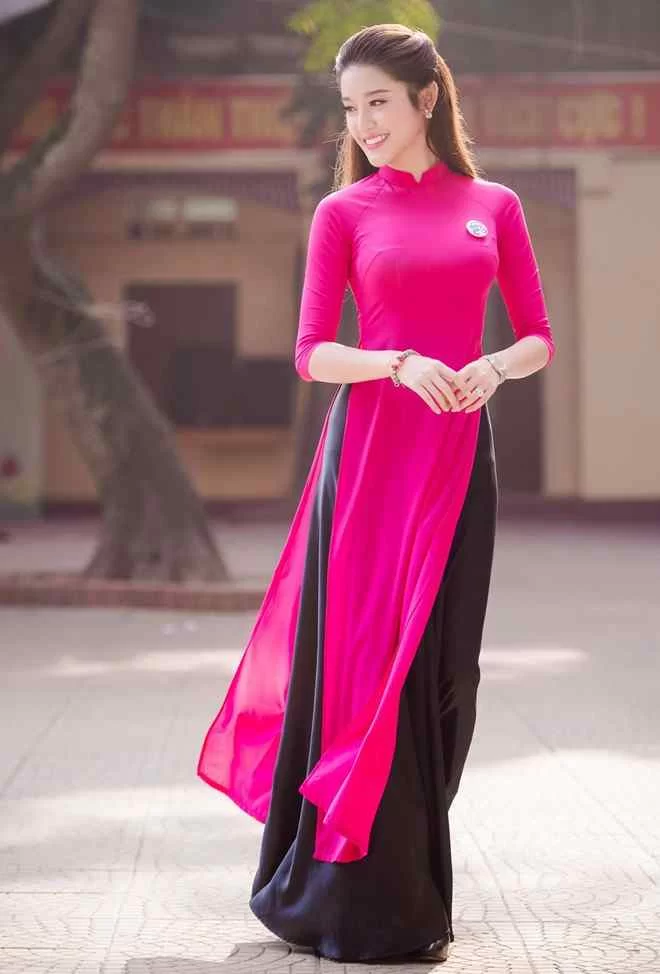 The girl in tunic
According to legend, the Two Trưng Ladies wore a two-paneled golden áo dài, with a golden parasol, on the backs of elephants in battles. Afterwards, to honor them, Vietnamese women avoided wearing four-paneled dresses in favor of two.
Vietnamese women, from North to South, all wore skirts and four-paneled dresses. Currently, this type of skirt is only seen in certain regions in the Red River Delta, and the four-paneled dress is still only the costume of folk artist groups. The áo dài, a symbol of Vietnamese women, however, has another genesis. Many wonder: since when has the Vietnamese áo dài existed?
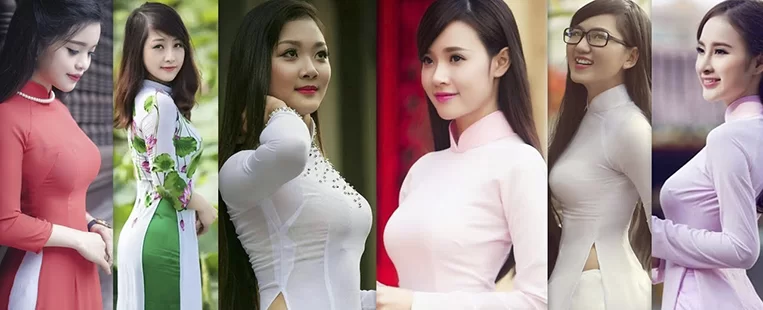
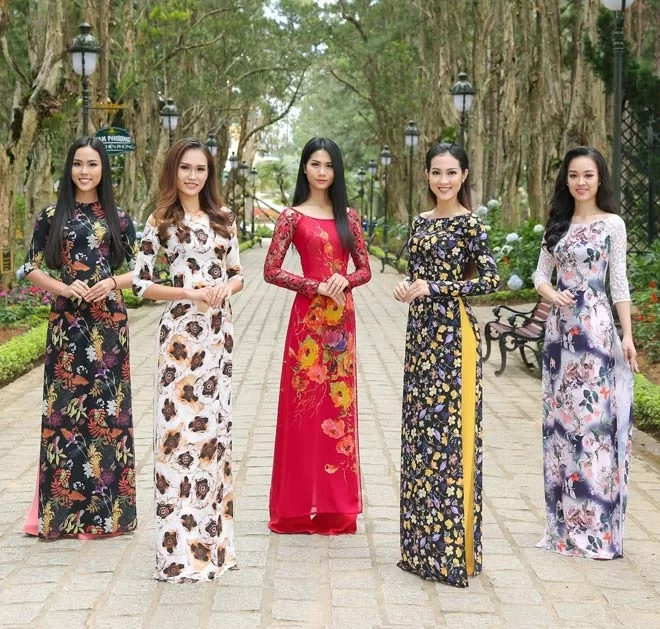 Girls in Vietnamese aodai
In history, the conflict between the Trịnh and the Nguyễn lasted for nearly 200 years. In the North, King Lê and Lord Trịnh reigned. In the South, the Nguyễn lords, seemingly subservient to the Lê, in reality took Phu Xuân as the capital of Đàng Trong (southern part of the country) for their imperishable work. In 1847, the people heard a prophecy: "Bát đại thời hoàn Trung đô" which means that after eight generations, one must return to the capital (known as Thang Long). The prophecy worried Nguyen Phuc Khoat. Because it had been eight generations from the first lord (known as Nguyen Hoang) to him. Nguyen Phuc Khoat was worried, because it would be a disaster to surrender to the Trịnh in the capital, after 200 years of war against them, with so many great difficulties in expanding the nation all the way to Ca Mau. Day and night, he could not eat or sleep. Finally, he gathered all his subjects to discuss a solution. The best solution, according to his subjects, was to proclaim himself emperor and establish a new capital. But, to have a new kingdom to change destiny, it was necessary to change ceremonies, culture, but above all, costumes. Nguyen Phuc Khoat accepted this and entrusted the mission to the great mandarins.
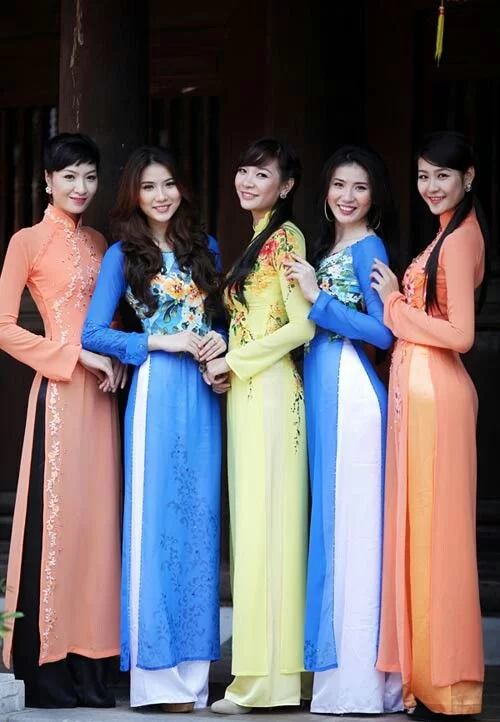 Vietnamese Aodai
From then on, Phuc Khoat ascended the throne under the title Vo Vuong, and took Phu Xuan as the capital. The ceremonies in the court and the customs among the people were all changed. To distinguish them from northern women wearing skirts, southern women wore trousers (two legs) like men. Võ Vương's policy caused a costume crisis in Phu Xuan. Women did not accept it and protested violently. Protesting without being able to do anything to change the "royal will," they had to wear trousers from then on. However, with a feudal mindset, Võ Vương, finding that women were too suggestive in trousers, asked the mandarins to create the current Vietnamese áo dài in the form of the Chăm áo dài (unsplit) and that of Shanghai women (split up to the knees). The first áo dài resembled that of the Chăm and was split. As Vietnamese culture developed in Hue, the Vietnamese áo dài has elements from both the North and the South.
In the past, kings, for the interest of their class and family, made choices against tradition, against the nation, which were suppressed by the people. Fortunately, two-legged trousers and the Vietnamese áo dài, although created in such situations, fit the figure of Vietnamese women well and enhance the beauty of women from both the North and the South. They have therefore become a cultural asset of Vietnamese women.
Until the beginning of the 20th century, most of the áo dài worn by urban women had five panels. Each panel, front or back, had two attached side border strips. And a fifth strip was added to the right, in front. The sleeves were attached at the elbows. If the panels and sleeves were attached, it was because good fabrics like silk, voile, brocade... were once only 40 centimeters wide. The collar, sleeves, and torso often clung to the body, the panel was not restricted at the sides then widened to the borders. The borders were often wide, 80 centimeters, but the collar was only 2 or 3 centimeters high.
From the 1930s to the 1940s, the form of the áo dài did not change much, but urban women began to wear brighter colors, imported from Europe. The hem of the áo dài during this period was often extended to 20 centimeters from the ankle. From then until the end of the 20th century, young girls everywhere wore the áo dài with white pants. Black pants were reserved for married women. Some áo dài designers began to appear, but only the knot was removed because Western fabric was wider in size than local fabric. The sleeves were still knotted. At that time, in Hanoi, the tailors Cát Tường in Hang Da street and some places in Hang Trong, Hang Bong were well-known. In 1939, stylist Cat Tuong presented a new model of áo dài, quite Westernized, called Le mur. Le mur kept the shape of the ordinary áo dài, but the collar was heart-shaped or sometimes a folded collar with a knot in front. The puffed shoulders were knotted to the sleeves. Le mur was then considered a daring step and was only worn by socialite artists. But by 1943, this model fell into oblivion. Until the 1950s, the sides began to be narrowed. Tailors cut the fabric according to the body. The back panel was wider than the front, especially the buttocks, so that it cinched the waist without being restricted; the panel was cut narrower, the collar higher and the hem longer.
During the 1960s, the áo dài changed the most because bras were more widely used. The sides were narrowed and the áo dài sometimes became very tight to lift the bust. It was slit high on the sides to show the edge of the pants. The panels were longer, down to the ankles, and the collar was round.
In the late 1960s and early 1970s, to adapt to short skirts and wide-leg jeans of young hippies, the "mini áo dài" emerged and quickly became the preferred fashion. The panels were narrower and shorter, sometimes down to the knees, the tunic was no longer restricted but still tight at the waist; the collar was lower, by 3 centimeters, the shoulders resembled those of a raglan for the bust and the sleeves became tighter at the waist; the pants had longer and 60 centimeters wide legs. From then until 1990, there were not many changes compared to tradition, except for new models, for example, the tunic and pants were of the same color, but this was not popular...
Currently, in Vietnam, many áo dài designers, with a lot of fabric material, are looking to create new models... The new materials are often fabrics decorated with painting or embroidery.
However, all these changes stop at the material or ornamental patterns, the model still follows the old formula, which means it is not very different from the one worn by the 17th-century Ngoc Nu statue in Dau pagoda, Thuan Thanh, Bac Ninh.
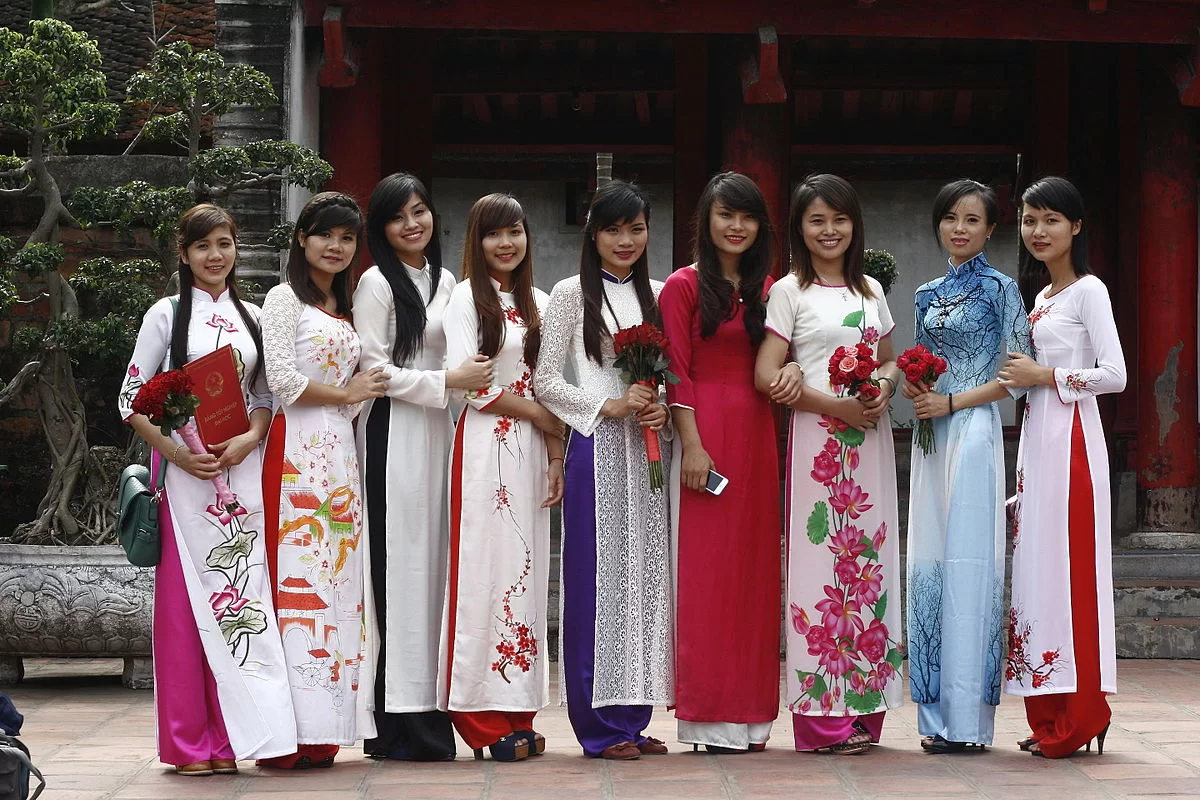
The áo dài has become an indispensable costume for Vietnamese women, without distinction between a diplomat and a visitor to Paris or New York or an athlete - receptionist at the Olympic Games. In the eyes of the world, at the sight of a woman in an áo dài, in any forum, she is immediately recognized as Vietnamese without introduction.
| * If this article is interesting and useful please share it with your Friends and people around you by choosing the sharing channel below please! * If you want to travel to Vietnam and really discover it in depth with the most authentic corners and the most typical cultures, we suggest you take a tailor-made trip to your wishes with a French-speaking travel agency in Vietnam like Typic Travel. Click our button "Free quote" or "Tailor-made trip" or send an email to Typic Travel * If you are simply looking for an idea of trips to Vietnam or Indochinese Countries Typic Travel offers you some main ideas according to the category of our trips on "idea of our trips" or follow us on one of your social networks to get more permanent info: |
|
Follow us on:
|
TripAdvisor | Facebook | Petit Futé | Youtube | Twitter | Instagram
|
