

Katê Festival: A Traveller's Guide to Vietnam's Biggest Cham Celebration
Most international travellers have never heard of Katê Festival, and that's understandable — search online for "Katê Festival Vietnam" and you'll find surprisingly little written in English, and the festival takes place in a region that many visitors skip entirely. This guide explains what the festival is, who celebrates it, when it falls in 2026, and how to experience it respectfully, whether as a focused trip to Ninh Thuan or as part of a longer, tailor-made tour through Central Vietnam. - Last updated: September 2026
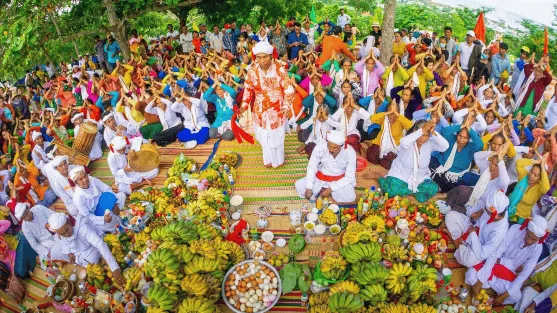
Every year, in the dry hills around Phan Rang in south-central Vietnam, drums and ceremonial horns announce the start of Katê Festival (also written "Kate Festival") — the most important annual celebration of the Cham people, one of Vietnam's 54 recognised ethnic groups. For three days, ancient brick towers that stand quiet for most of the year fill with families in traditional dress, carrying offerings to honour their ancestors, their kings, and the deities of a kingdom that once ruled much of the Vietnamese coastline.
Table of contents
- What Is the Katê Festival?
- The Cham People and Their Culture
- When and Where Is the Katê Festival Celebrated?
- What Happens During Katê Festival?
- The Main Cham Towers and Cultural Sites to See
- What Is It Like to Experience the Katê Festival as a Traveller?
- Why Katê Festival Is Worth Experiencing
- How to Include Katê Festival in a Vietnam Trip
- Practical Travel Tips for Katê Festival
- Frequently Asked Questions
- Plan a Cultural Experience with Typic Travel
What Is the Katê Festival?
Katê Festival is the biggest Cham festival of the year — the most important annual event for the Cham Balamon community, Cham people who follow a localised, centuries-old form of Hinduism. It is held to give thanks to Cham kings and deities, to honour ancestors, and to pray for good weather, good harvests, and wellbeing in the year ahead.
The name is thought to come from "Kattika", a Sanskrit and Hindu-calendar term for the seventh month, which points to the deep historical links between Cham Balamon belief and Hindu traditions that reached Southeast Asia over a thousand years ago.
Katê is celebrated by Cham communities living in south-central Vietnam, most visibly around Ninh Thuan (now administratively part of Khanh Hoa province) and Binh Thuan (now part of Lam Dong province). It centres on ancient brick towers — including the well-known Po Klong Garai — where religious dignitaries and ordinary families gather over three days of ritual, music, and celebration.
For the Cham community, Katê is somewhere between a religious festival and a homecoming: Cham people who have moved away for work or study make a point of returning for it, similar in feeling to how many Vietnamese treat Tet (Lunar New Year). For visitors, it's a rare chance to see a living, non-touristic tradition rather than a performance staged for cameras — which is exactly why it's worth understanding the culture behind it before you go.
The Cham People and Their Culture
Who Are the Cham People?
The Cham are an Austronesian ethnic group and among Vietnam's oldest documented communities. They are descendants of Champa, a maritime kingdom that controlled much of central and southern coastal Vietnam for well over a thousand years, from roughly the 2nd century AD until it was gradually absorbed into Vietnam between the 15th and 19th centuries. At its height, Champa was a network of trading ports and Hindu-Buddhist temple complexes — including My Son, near Hoi An, now a UNESCO World Heritage Site.
According to Vietnam's most recent national census, close to 180,000 Cham people live in the country today, mostly concentrated in the south-central coastal provinces and, further south, in the Mekong Delta and Ho Chi Minh City area.
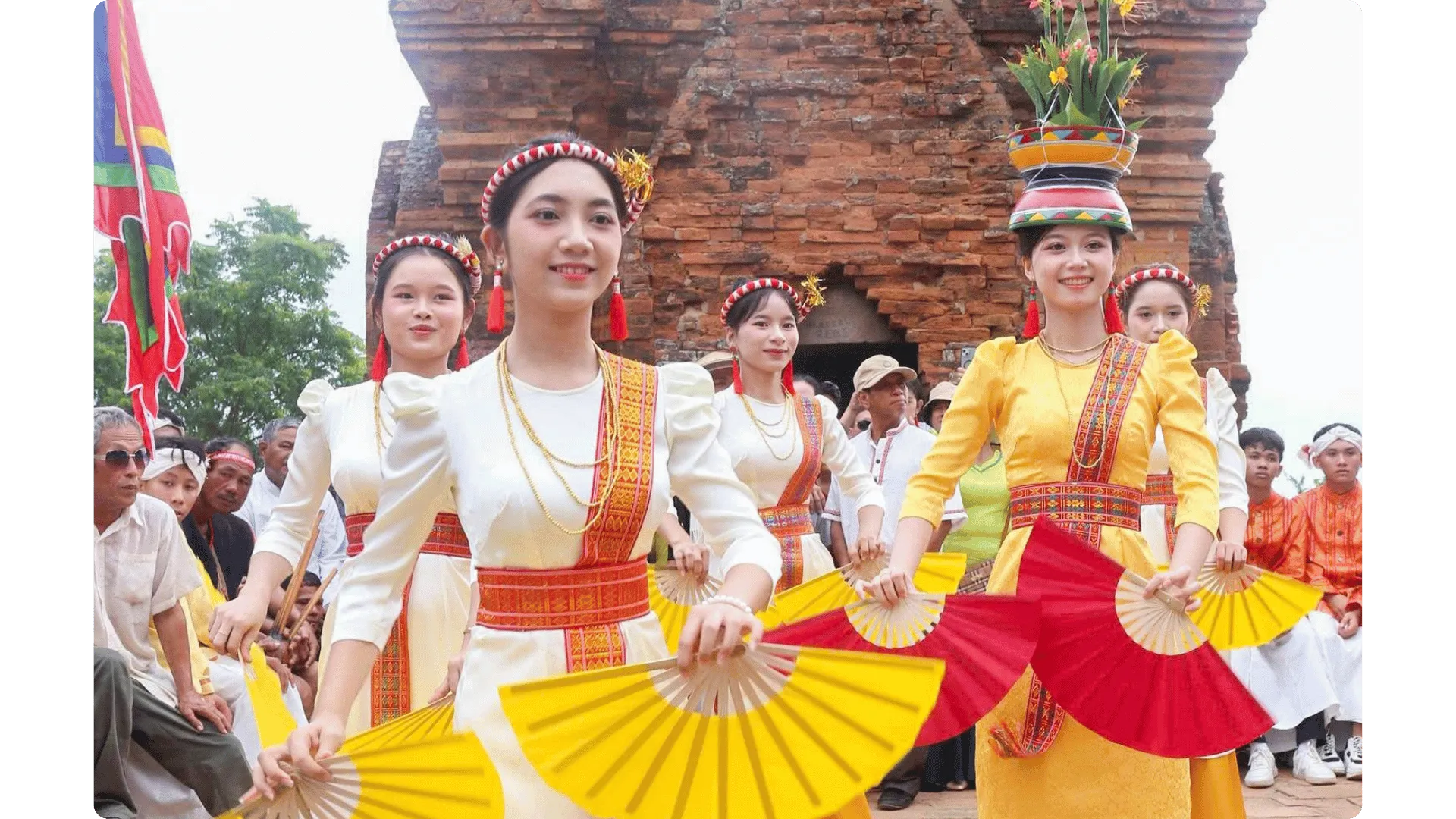
One detail that often surprises visitors: the Cham Balamon community, who celebrate Katê, is traditionally matrilineal. Family lineage and property customarily pass through the female line, and the youngest daughter typically inherits the family home — a structure quite different from the patrilineal norm elsewhere in Vietnam.
Cham Beliefs and Traditions Today
Cham culture isn't a single, uniform tradition. Broadly speaking, Cham communities in Vietnam follow one of three faiths:
- Balamon (also called Ahier): a localised form of Hinduism, blended over centuries with indigenous beliefs and ancestor worship. This is the community that celebrates Katê.
- Bani (also called Awal): a distinct, localised form of Islam found only among Cham communities in Ninh Thuan and Binh Thuan, with its own religious calendar and practices, including the fasting month of Ramuwan.
- Islam: mainstream Sunni Islam, practised mainly by Cham communities further south and southwest, around An Giang and the Mekong Delta.
Historically, Balamon and Bani Cham communities have lived side by side in the same villages around Phan Rang and Phan Thiet, with long-standing customs of mutual visits and cooperation between the two groups — including some Bani participation in aspects of Katê.
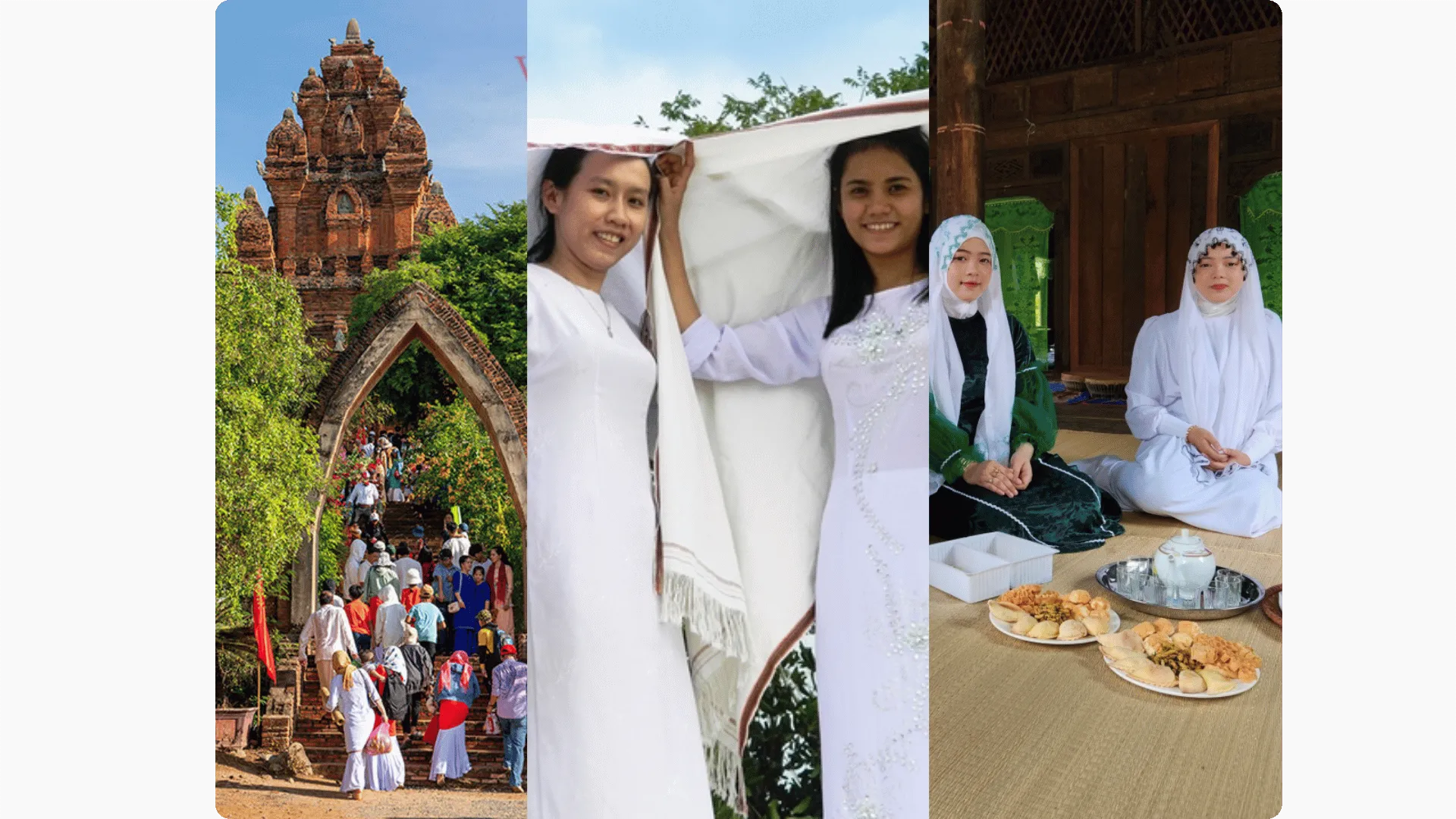
Beyond religion, Cham identity is expressed through a distinct language (part of the Austronesian family, related to Malay and languages of the Pacific), a centuries-old script, traditional weaving and pottery, and an oral tradition of poetry and legend that still shapes how festivals like Katê are understood today.
>> You may like: Religion of Vietnam: The complete guide to spiritual beliefs and practices
Why Preserving Cham Heritage Matters
Cham heritage sits at a delicate point. Cham towers are centuries old and built from unmortared fired brick using techniques that aren't fully understood even by modern conservators. Cham language use is declining among younger generations, and traditional crafts survive in only a handful of villages.
At the same time, there are genuine signs of revival. Bau Truc, a Cham pottery village near Phan Rang, is one of the oldest pottery-making communities in Southeast Asia, and its craft was inscribed by UNESCO on the List of Intangible Cultural Heritage in Need of Urgent Safeguarding in 2022. Katê Festival itself has been officially recognised by Vietnam's Ministry of Culture, Sports and Tourism as a National Intangible Cultural Heritage, both in Ninh Thuan and in Binh Thuan. Local authorities increasingly frame tourism as part of preservation — responsible visits can support artisans, guides, and performers directly, which is one reason it's worth visiting Cham heritage sites thoughtfully rather than rushing through them.
When and Where Is the Katê Festival Celebrated?
Understanding the Cham Calendar
Katê begins on the first day of the seventh month of the Cham calendar, a lunar-solar system that doesn't map neatly onto fixed Gregorian dates. In practice, this means the festival usually falls somewhere between late September and mid-October each year, but the exact date shifts: in recent years it has opened as early as 1 October and as late as 21 October. Local cultural departments confirm the precise schedule only shortly beforehand, once Cham religious dignitaries have set the date.
Katê Festival 2026: Dates and Where to Go
Based on announcements from Vietnamese state media and provincial authorities in September 2026, here is what's confirmed so far:
- Main ceremony day: 10 October 2026 — the 1st day of the 7th month of the Cham calendar. This is when the costume procession, tower-opening rituals, and main offering ceremonies take place at Po Klong Garai and Po Rome towers.
- Wider festival period, Ninh Thuan area: roughly 5–12 October 2026, which this year also includes the inaugural Bau Truc Cham Pottery Festival, held alongside Katê in Ninh Phuoc.
- Phan Thiet area: 9–12 October 2026 at Po Sah Inư Tower, under the theme "Preserving and Spreading the Values of Cham Cultural Heritage."
Because these dates depend on a calendar system that isn't fixed to the Gregorian year, we'd recommend confirming them again closer to your travel dates — something a local travel agency can help with as part of planning a tailor-made tour around the festival.
Where the Festival Takes Place
Katê's largest celebrations happen in what is still widely known as Ninh Thuan — the province was administratively merged into an expanded Khanh Hoa province in July 2025, but the name Ninh Thuan remains the everyday way locals and travellers refer to the area around Phan Rang–Thap Cham, so we'll continue to use it throughout this guide. A related, smaller set of celebrations takes place around Phan Thiet, in what was Binh Thuan province and is now part of Lam Dong province.
The main ritual sites are:
- Po Klong Garai Tower, about 9 km west of Phan Rang city
- Po Rome Tower, in Ninh Phuoc district
- Po Ina Nagar Temple, in Huu Duc village, Ninh Phuoc district
- Po Sah Inư Tower, near Phan Thiet
All of these sites hold their ceremonies on the same day, with broadly similar rituals, so travellers based in Ninh Thuan don't need to visit every site — Po Klong Garai alone gives a full picture of the festival.
What Happens During Katê Festival?
Katê unfolds through a set sequence of Cham traditional rituals each year, moving from temple ceremony to home and village celebration.
Day One: Welcoming the Sacred Costumes
The festival opens with a ceremony to receive the sacred costumes of Cham deities from the Raglai people, a neighbouring ethnic minority who traditionally serve as guardians of these garments between festivals. This exchange reflects a long-standing relationship between the two communities and is one of the more overlooked but genuinely interesting parts of Katê.
Day Two: The Main Procession and Temple Rituals
This is the festival's central day, and the one most visitors plan around. A procession — Cham religious dignitaries in formal dress at the front, followed by a palanquin carrying the sacred costumes, offering-bearers, musicians, and dancers — makes its way to the temple towers. At the tower, dignitaries open the doors, ritually bathe the sacred statue or linga-yoni (a Hindu symbol representing Shiva), dress it in the ceremonial costume, and perform the main offering ceremony.
Day Three Onward: Family and Village Celebrations
After the temple rites, celebrations move to individual villages and homes. Families make offerings to their ancestors, host visiting relatives, and often keep celebrating informally for several more days. If you're travelling independently, this is a good time to visit a craft village such as Bau Truc or My Nghiep, where you may see festival preparations continuing at a more relaxed pace.
Traditional Music, Dance, and Costumes
Cham traditional music defines the sound of Katê. Three instruments carry it: the Ginang (a barrel drum), the Paranung (a smaller hand drum), and the Saranai (a double-reed horn similar to an oboe). Together they accompany the procession and the Cham traditional dance performances that follow, including the graceful fan dances performed by Cham women.
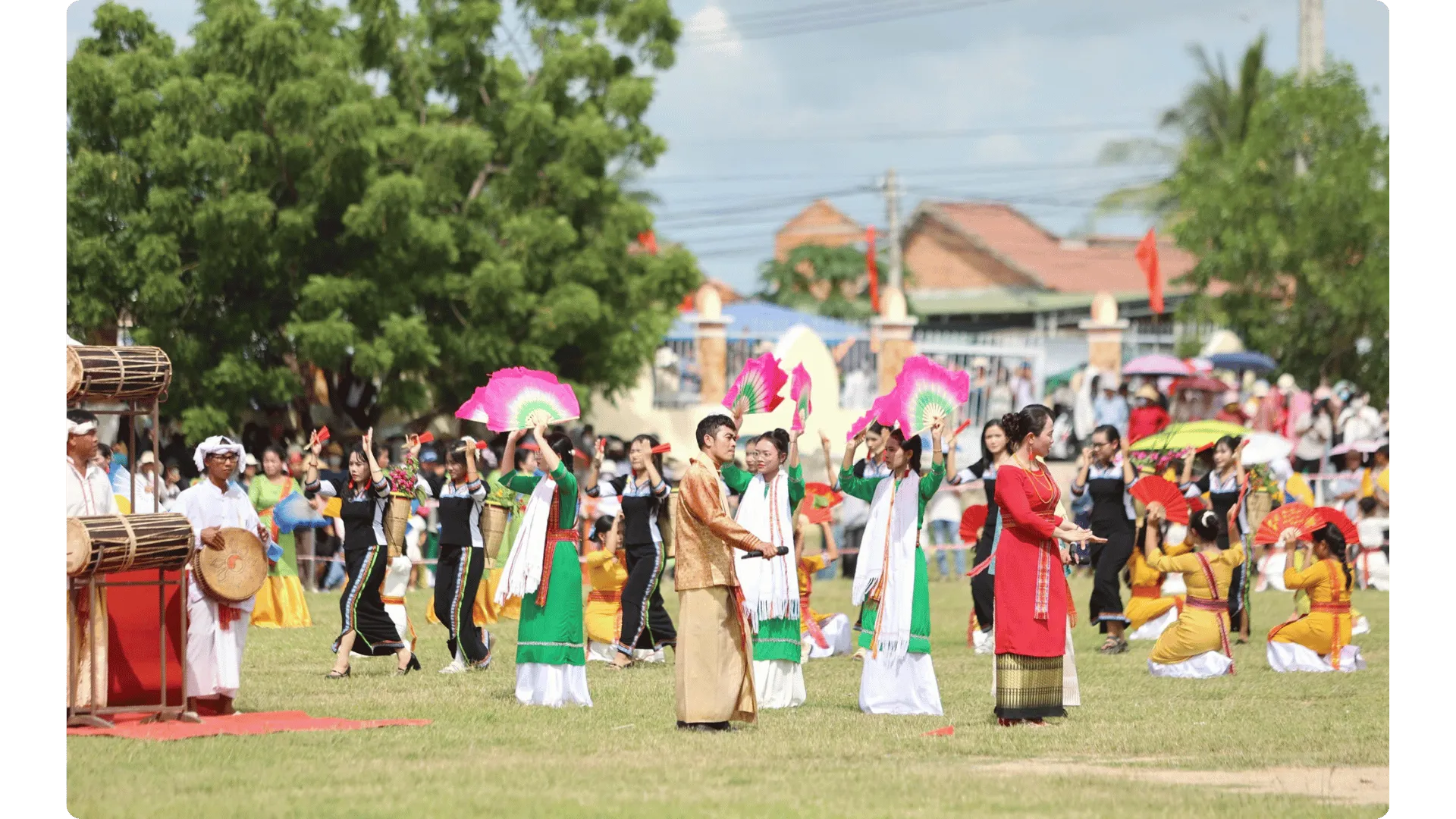
Cham costumes are central to the occasion, and their colours carry meaning: red represents vitality and good fortune, white represents purity, and black represents maturity. During the procession, men often wear red-and-white ceremonial robes, while women wear colourful, embroidered traditional dress with matching headscarves.
Offerings and Cultural Practices
Families bring offerings of rice, fruit, boiled chicken or goat, and traditional cakes (including a ginger cake known locally as bánh gừng), typically arranged on woven bamboo trays. These are presented at the towers and, later, at family altars — a practice rooted in gratitude rather than spectacle, even though it makes for striking photographs.
Sacred Ritual and What Visitors Can Observe
It's worth being clear about which parts of Katê are open and which are restricted, since the two are sometimes blurred in tourism marketing.
Open to the public:
- The procession from the village to the temple
- Music and folk dance performances in the temple courtyard and grounds
- General offerings and community gatherings around the towers
- Folk games and craft demonstrations that often run alongside the festival
Reserved for Cham dignitaries and community members:
- The innermost ritual of bathing and dressing the sacred statue or linga-yoni, usually performed out of public view inside the tower
- Certain prayers and invocations led by Cham priests (referred to as Ong Kadhar) and priestesses (Muk Pajau)
Visitors are welcome to watch respectfully from a reasonable distance during the restricted moments, but shouldn't expect — or ask — to get closer than the space Cham organisers set aside for the public.
The Main Cham Towers and Cultural Sites to See
Katê is the best reason to visit Ninh Thuan's Cham temples and towers, but they reward a visit at any time of year, festival or not. Here are the sites travellers ask about most, roughly in order of relevance to Katê.
Po Klong Garai Tower
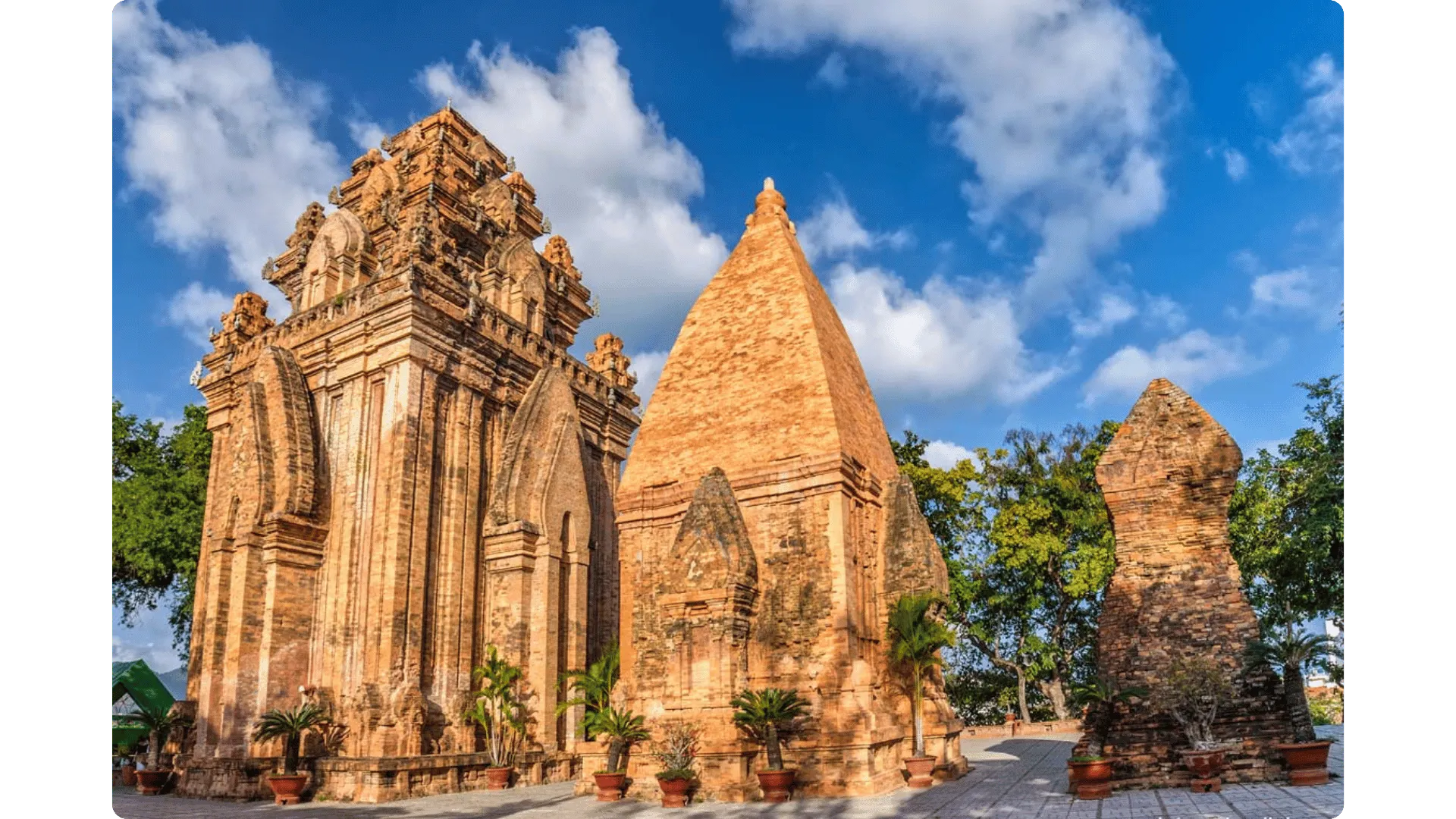
Po Klong Garai is the best-known and best-preserved Cham tower complex in Vietnam, and the main gathering point for Katê in the Ninh Thuan area. Built in the late 13th and early 14th centuries under King Jaya Simhavarman III, it was later rededicated to the memory of King Po Klong Garai (1151–1205), who is remembered for building irrigation canals and dams that are still partly in use today. According to Cham legend, he began life as a lowly cowherd before rising to the throne, and later became a deified protector of the Cham people.
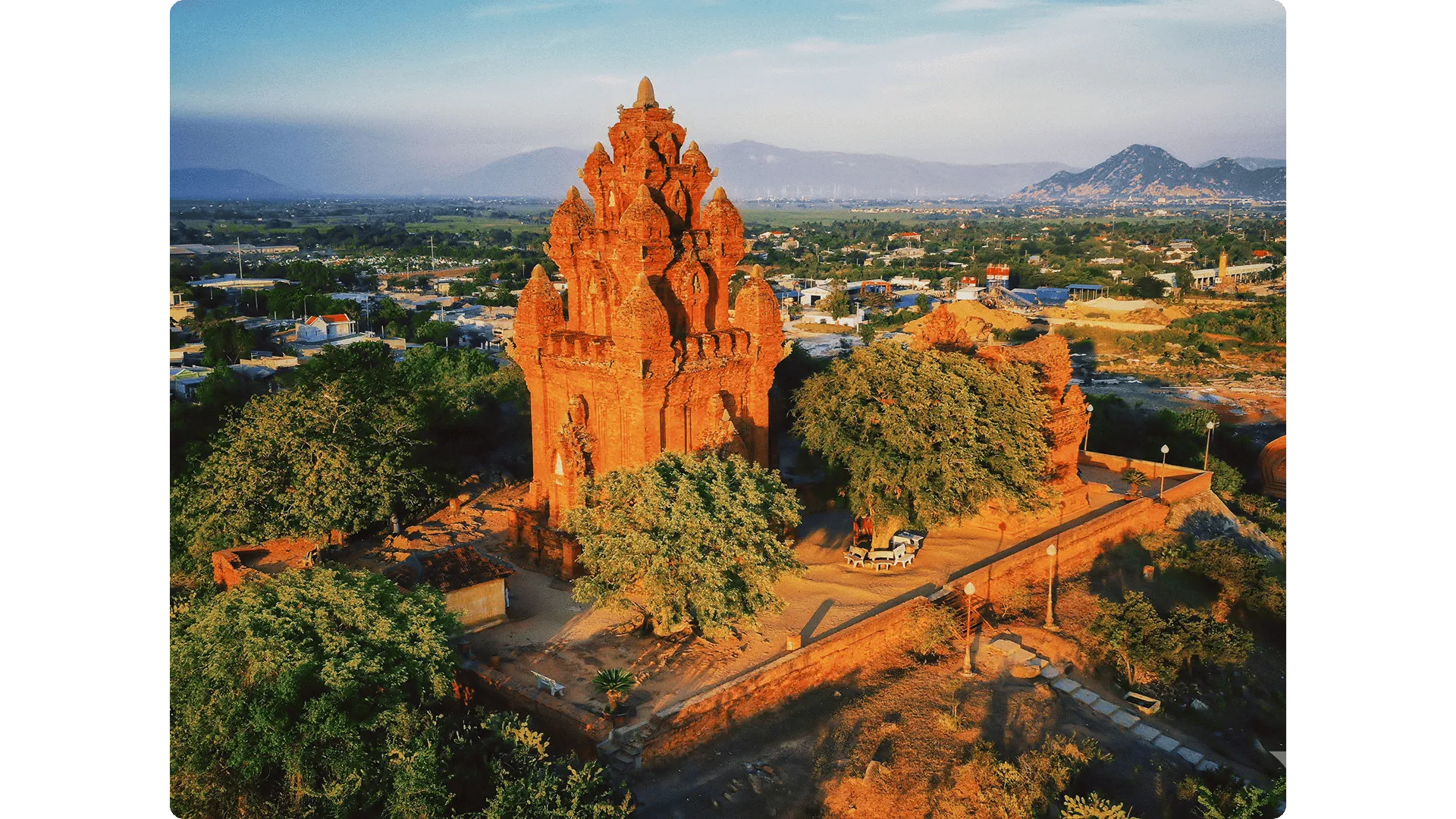
The complex, on a hill about 9 km west of Phan Rang, consists of three towers: the main tower (housing the central shrine), a gate tower, and a smaller "fire tower." It was recognised as a Special National Relic Site in 2016, and it's open to visitors year-round, not only during Katê.
Po Rome Tower
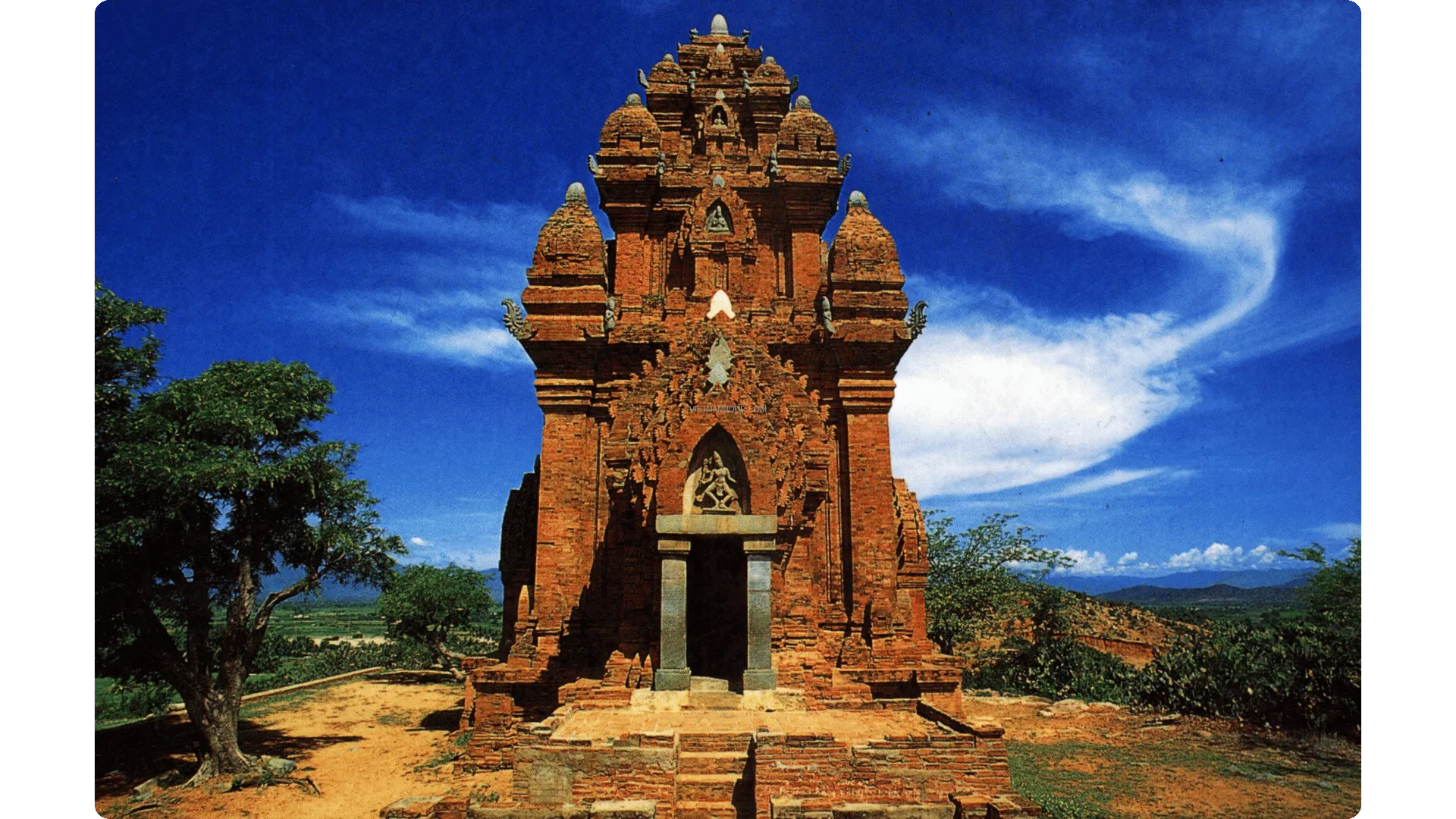
A short distance from Po Klong Garai, Po Rome Tower is dedicated to another deified Cham king and takes part in the same day's Katê rituals. It sees fewer tourists than Po Klong Garai, which some travellers actually prefer if they'd rather watch the ceremonies without large crowds.
Po Nagar Towers, Nha Trang
If your trip also includes Nha Trang — now within the same expanded Khanh Hoa province as Ninh Thuan, which makes combining the two easier than it used to be — the Po Nagar Towers are worth a stop. Built in stages between the 8th and 13th centuries on a hill above the Cai River, they honour the goddess Po Ina Nagar, revered as the "Mother of the Land" who is credited, in Cham belief, with teaching the people agriculture and weaving.
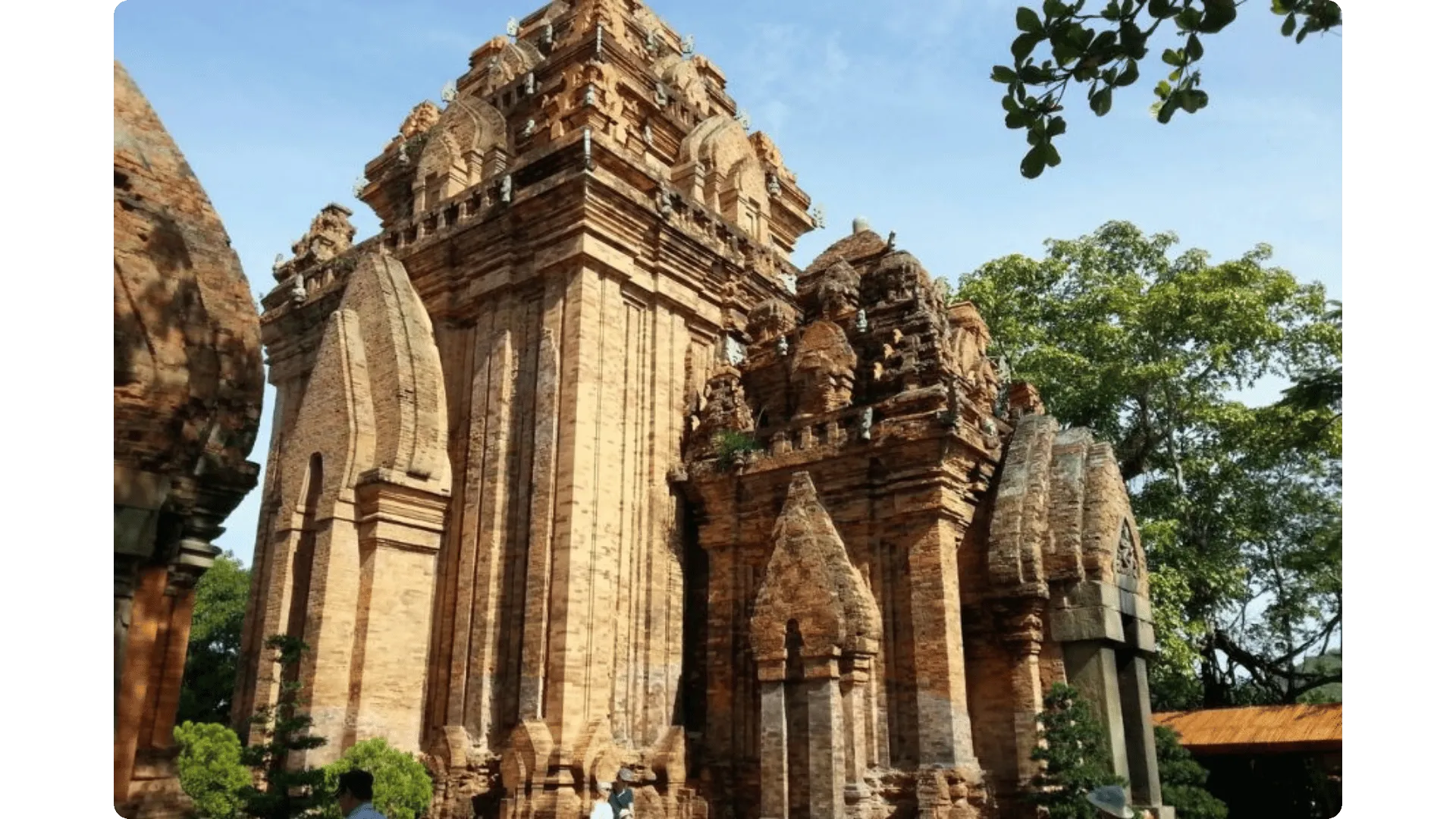
One point of genuine confusion worth clearing up: you'll see the name "Po Nagar" attached to more than one place. The grand towers in Nha Trang and the smaller Po Ina Nagar temple in Huu Duc village (part of the Ninh Thuan Katê sites listed above) both honour the same goddess figure, but they are two separate sites. Po Nagar in Nha Trang holds its own annual festival in spring, distinct from Katê, so don't expect Katê-specific ceremonies there in October — it's a worthwhile Cham heritage site in its own right, just not part of the Katê circuit.
Po Sah Inư Tower, Near Phan Thiet
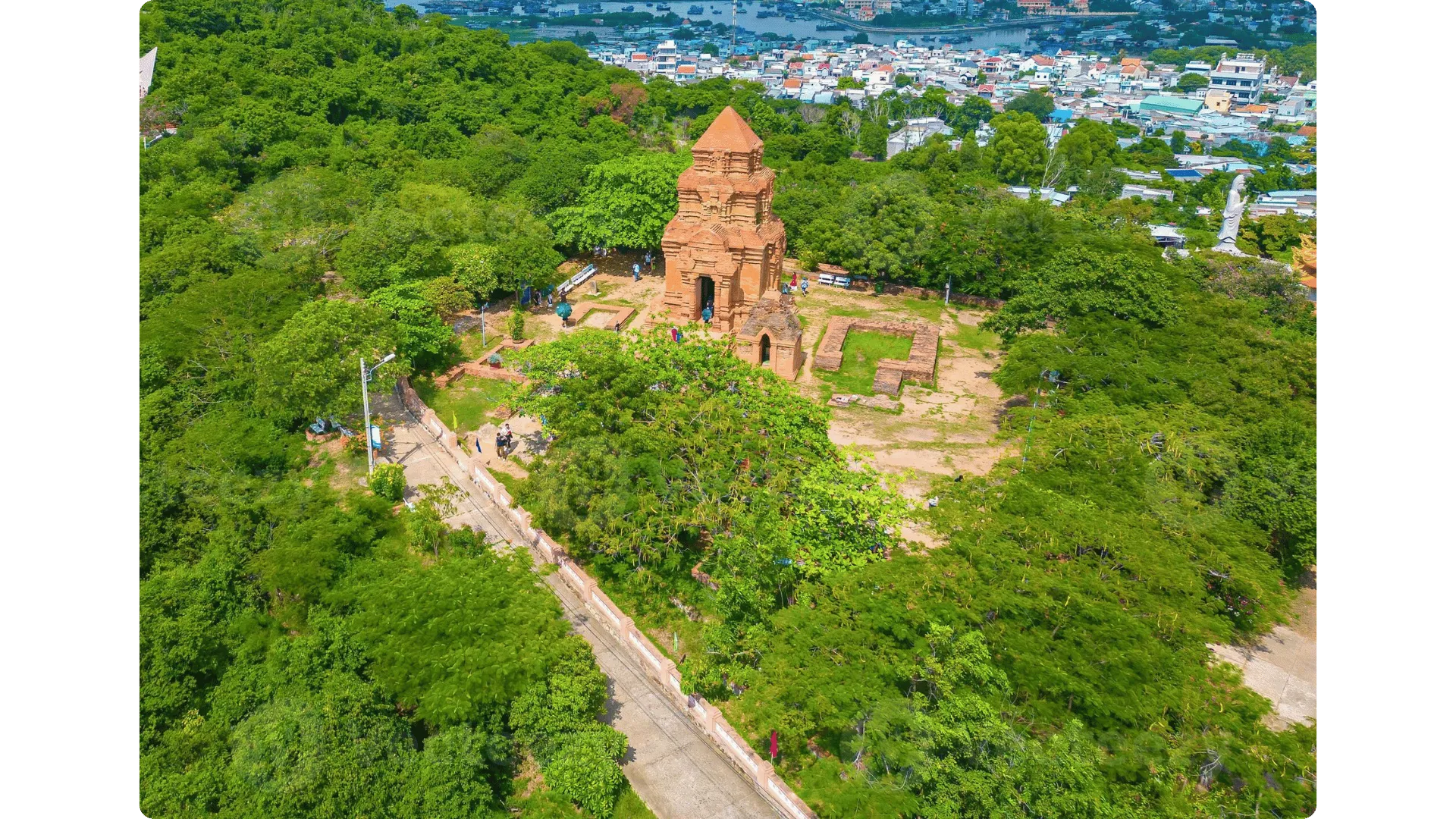
For travellers extending their trip toward Phan Thiet or Mui Ne (in what was Binh Thuan province, now part of Lam Dong), Po Sah Inư Tower hosts its own Katê programme, with a similar sequence of costume procession, tower-opening rites, and cultural performances, plus folk-art and craft displays that run over several days.
What Is It Like to Experience the Katê Festival as a Traveller?
What to Expect
Expect crowds, heat, and a genuine community event rather than a polished show. Roads and temple grounds near Po Klong Garai get busy on the main ceremony day, with Cham families arriving from across the region alongside domestic and, increasingly, international visitors. There's no formal "seating" for tourists — you watch from the same open ground as everyone else, so arriving early gives you a better vantage point.
Respectful Behaviour at Ceremonies
Katê is, first and foremost, a religious occasion for the Cham community, not a festival staged for visitors. A few basics go a long way: keep your voice down near active rituals, don't step into roped-off or clearly reserved areas, follow the lead of local families around when to stand back, and avoid touching sacred objects, statues, or offerings.
Photography Considerations
Photography is generally welcome in the outdoor procession and performance areas, but it's worth being more careful around the innermost temple rituals, where photography may be restricted or discouraged out of respect. If you want a close-up portrait of someone in traditional costume, a smile and a quick gesture asking permission is appreciated, and always the safer choice, particularly with elders and religious dignitaries. Avoid using flash near ritual spaces, and be mindful of blocking other people's view, especially Cham families who have travelled specifically to take part.
What to Wear at the Temples
Modest clothing is appropriate at all times inside the temple grounds: shoulders and knees covered is a safe rule of thumb, similar to visiting a pagoda elsewhere in Vietnam. Loose, breathable fabrics work best given the heat. You may be asked to remove your shoes at specific points, so shoes that slip on and off easily are more practical than boots or lace-ups.
Can Tourists Take Part, or Should They Just Observe?
Mostly, visitors observe rather than participate in the religious rites themselves, and that's the appropriate role for anyone outside the Cham community. That said, Katê isn't purely a spectator event: at some village-level celebrations, visitors are welcomed to try on traditional costumes, join in folk dances, or take part in games alongside local families — but this happens on the community's terms, not by visitors inserting themselves. If in doubt, watch first, and only join in if you're clearly invited to.
Why Katê Festival Is Worth Experiencing
Katê is worth experiencing for what it teaches you, not simply for what it looks like. Unlike some of Vietnam's better-known festivals, which have been substantially reshaped around tourism, Katê remains organised primarily by and for the Cham community itself — the ceremonies would happen whether or not any visitors showed up. That makes it a genuinely useful way to understand a part of Vietnamese history that's easy to miss if you stick to Hanoi, Hoi An, and Ho Chi Minh City: Vietnam has long been home to more than one culture and more than one historical kingdom.
Compared with nationwide Vietnamese festivals like Tet (Lunar New Year) or the Mid-Autumn Festival, Katê is smaller in scale but more concentrated in a single region, which makes it easier to witness closely rather than from the edge of a citywide crowd. It also gives a clearer window into the country's religious diversity — Hindu-influenced ritual, ancestor worship, and Islamic tradition, coexisting within one ethnic community — that's rarely visible elsewhere in Central Vietnam.
If you're still weighing up what to see in Vietnam beyond the familiar Hanoi–Hoi An–Ho Chi Minh City route, or researching what to do in Vietnam during the shoulder season between the dry and rainy months, Katê is a solid, lesser-known answer to both questions.
How to Include Katê Festival in a Vietnam Trip
Pairing Katê With a Central Vietnam Itinerary
Ninh Thuan sits conveniently between two destinations many travellers already plan to visit: Nha Trang to the north and Da Lat or Phan Thiet/Mui Ne to the south. A typical Central Vietnam tour might combine a couple of beach days in Nha Trang, a detour to Ninh Thuan for Katê and the Cham towers, and onward travel to Da Lat's cooler hill scenery or Phan Thiet's sand dunes — all without significant backtracking.
If you only have a day to visit Ninh Thuan, the most efficient plan is usually: Po Klong Garai in the morning (arriving early during Katê), a Cham craft village such as Bau Truc or My Nghiep around midday, and a vineyard or coastal stop such as Vinh Hy Bay in the afternoon.
Discover Typic Travel’s Central Vietnam Tours here!
Building a Tailor-Made Trip Around the Festival
Because Katê's exact date changes every year and its main events are concentrated into a narrow window, building a trip around it works best with some local knowledge — confirming the current year's schedule, booking accommodation before the festival period gets busy, and sequencing the rest of your itinerary so you're not rushing between destinations. This is exactly the kind of detail a customised Vietnam tour with a local agency can take off your hands: rather than trying to reverse-engineer the Cham calendar yourself, you tell us what else you want to see — Hoi An, Hue, the Mekong Delta, or further afield in Cambodia and Laos — and we build a Ninh Thuan tour or a wider Vietnam itinerary around the confirmed dates.
Practical Travel Tips for Katê Festival
When to Go
Aim to arrive a day before the main ceremony and stay through it, since the single most important day is short and busy. Ninh Thuan is Vietnam's driest region, with a long dry season roughly from December to August, but Katê itself falls right at the start of the shorter rainy season (September to November), so pack for the possibility of a brief shower alongside plenty of sun.
Where to Stay
Phan Rang city has a modest but growing range of hotels and is the most convenient base for the festival itself. Ninh Chu Beach, a short drive away, offers a more resort-style stay if you'd like beach time either side of the festival. Some travellers prefer to stay in Nha Trang, now roughly two and a half hours away by road, and visit Ninh Thuan as a long day trip — a reasonable option if you're also spending time on Nha Trang's beaches, though it does mean less flexibility around the festival's early-morning ceremonies.
Getting There and Around
The nearest airport is Cam Ranh International Airport (CXR), around 55–60 km (roughly 1 to 1.5 hours by road) from Phan Rang, with domestic connections across Vietnam and a growing number of international routes. Phan Rang–Thap Cham also has its own railway station on the north–south Reunification Express line, and regular buses connect Phan Rang with Nha Trang (about 2.5 hours), Phan Thiet/Mui Ne (about 2 hours), and Ho Chi Minh City (5 to 7 hours). Once you're in the area, a private car with driver is the most practical way to reach Po Klong Garai and nearby sites, particularly on the festival's busiest day, when parking and road access near the towers get congested.
What to Wear and Pack
Beyond the temple dress code covered above, plan for strong sun: a hat, sunglasses, and sunscreen are genuinely necessary given Ninh Thuan's dry, high-sunshine climate. Comfortable closed-toe sandals or shoes that are easy to slip off work better than heavy footwear. Bring more water than you think you'll need, as shade is limited around the towers, and a light scarf or wrap can double as sun protection and modest covering if needed.
Cultural Etiquette
Ask before photographing individuals up close, especially religious dignitaries. Don't touch temple structures, statues, or offerings. Keep noise down near active rituals, and be patient with crowding and informal queuing, which is normal at a community event of this scale rather than a managed tourist attraction.
Photography Tips
The procession and courtyard performances offer the best photo opportunities, particularly in the earlier, cooler part of the morning when the light is softer and crowds are thinner. A zoom lens is useful for capturing ritual moments from a respectful distance without needing to get close. If you're travelling with a guide, they can usually advise in real time on which moments are appropriate to photograph.
Frequently Asked Questions
What is Katê Festival?
⇒ Katê Festival is the most important annual festival of the Cham Balamon community in Vietnam. It's a three-day celebration of temple rituals, processions, music, and family gatherings, held to honour Cham deities, kings, and ancestors.
When is the Kate Festival in Vietnam in 2026?
⇒ The main rituals fall on 10 October 2026, the 1st day of the 7th month of the Cham calendar, with a wider festival programme running from around 5 to 12 October 2026 in the Ninh Thuan area and 9 to 12 October 2026 around Phan Thiet. Because the date follows a lunar-solar calendar, it's worth reconfirming closer to your travel dates.
Where is the Katê Festival held?
⇒ The largest ceremonies take place at Cham towers in Ninh Thuan (now part of Khanh Hoa province) — Po Klong Garai and Po Rome — and at Po Sah Inư Tower near Phan Thiet (now part of Lam Dong province). Family and village celebrations continue for several more days afterward.
Who celebrates the Katê Festival?
⇒ Katê is celebrated primarily by the Cham Balamon community, who practise a localised form of Hinduism. Neighbouring communities, including the Raglai ethnic minority, also take part in specific elements of the festival.
Can tourists attend the Katê Festival?
⇒ Yes. The procession, music, dance, and outdoor ceremonies are open to the public, and local tourism authorities welcome visitors. Certain inner-temple rites are reserved for Cham dignitaries and community members, but there's plenty for visitors to see respectfully from the surrounding grounds.
What should I wear to the Katê Festival?
⇒ Modest clothing that covers your shoulders and knees is appropriate at the temples, along with lightweight, breathable fabrics for the heat. Choose shoes that are easy to remove, since you may be asked to take them off in certain areas.
What happens during the Katê Festival?
⇒ The festival opens with a ceremony welcoming the sacred costumes, followed by a grand procession to the temple towers, the opening of the temple doors, ritual bathing and dressing of sacred statues, and offerings of rice, fruit, and traditional cakes. Music, folk dances, and games run alongside the rituals, and the following days are spent celebrating with family.
Is the Katê Festival religious?
⇒ Yes. At its core, Katê is a religious festival rooted in Cham Balamon belief, honouring deities, deified kings, and ancestors. Over time it has also become a broader cultural event that the wider community, and visitors, take part in.
Where can I see Cham culture in Vietnam?
⇒ Beyond the Katê Festival itself, Cham heritage can be seen at the Po Nagar Towers in Nha Trang, My Son Sanctuary near Hoi An, and craft villages such as Bau Truc (pottery) and My Nghiep (weaving) near Phan Rang.
How can I include Katê Festival in a tailor-made Vietnam tour?
⇒ Katê pairs naturally with a Central Vietnam itinerary that also covers Nha Trang, Da Lat, or Hoi An. A local travel agency can confirm the current year's exact dates, arrange transport and accommodation around the festival period, and build the rest of your trip — whether a short Ninh Thuan tour or a longer Vietnam and Indochina itinerary — around it.
Plan a Cultural Experience with Typic Travel
If you're planning a trip around Katê Festival 2026, or simply want Cham culture and Central Vietnam included in a wider itinerary, our local travel planning team is happy to help you work out the details.
At Typic Travel, we design tailor-made tours that connect you directly with the rhythm of local life. Whether you want to build a complete Vietnam cultural experience around a vibrant highland festival, get in touch with our team to start shaping your trip.